
Dallas Police Say They Will Enforce Texas' New THC Restrictions: What Dallas Residents Need to Know
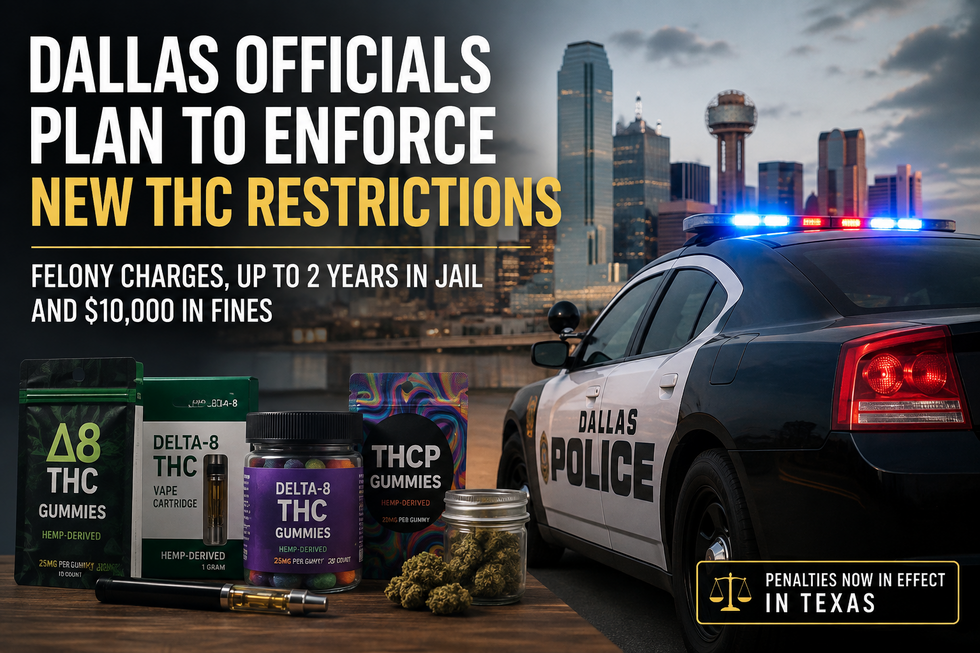
Texas' new restrictions on certain hemp-derived THC products took effect on July 31, 2026. Now, Dallas residents are getting a clearer picture of what enforcement may actually look like.
The takeaway is important: Dallas law enforcement says it intends to enforce the new THC rules.
That matters because products that Texans could legally purchase from smoke shops, CBD stores, convenience stores, and other retailers only weeks ago may now potentially expose someone to a felony drug charge.
The situation is especially confusing because not every Texas jurisdiction appears to be taking the same approach to enforcement. A product may look like something that was legally purchased before the rule change—or may even have been purchased before July 31—but possession after the change could create serious legal problems depending on the substance involved.
For people in Dallas and throughout North Texas, understanding the new rules is no longer simply a question of what stores are allowed to sell. It can be a question of whether possessing a particular THC product could lead to an arrest and felony prosecution.
Dallas Police Say They Will Enforce the New THC Rules
According to reporting, the Dallas Police Department has indicated that it will enforce the new regulations as officers encounter potential violations.
DPD reportedly does not plan a special enforcement rollout or separate crackdown. Instead, potential THC violations can arise through normal police activity, complaints, proactive enforcement, traffic stops, and criminal investigations.
That distinction should not give Dallas residents much comfort.
Police do not need to conduct a citywide THC sweep for the new rules to have serious consequences. A THC product can potentially become an issue during an otherwise unrelated encounter with law enforcement.
For example, police may encounter suspected THC products during:
-
A traffic stop;
-
A vehicle search;
-
An arrest on an unrelated allegation;
-
A disturbance call;
-
A DWI investigation;
-
A search pursuant to a warrant;
-
A probation-related investigation; or
-
Another criminal investigation.
Once police discover a vape cartridge, gummy, flower, concentrate, or other cannabis-related product, the question becomes what the product actually contains and how Texas law classifies it.
That question is considerably more complicated today than it was just a few months ago.
Some THC Possession Can Now Mean a Felony in Dallas
One of the most important things Dallas residents need to understand is the enormous difference between a misdemeanor marijuana allegation and a felony controlled-substance allegation.
Possession of less than four ounces of marijuana leaf can still fall within misdemeanor punishment ranges under Texas law.
But certain THC products affected by the new rules may be treated as controlled substances. Depending on the substance, amount, and applicable law, possession can potentially result in criminal drug charges.
That distinction changes almost everything about a case.
A felony arrest can mean greater potential punishment, more serious collateral consequences, higher bond considerations, and a criminal record that can affect employment, housing, professional licensing, education, and other areas of a person's life.
For some lower-level felony allegations, the potential punishment can include up to two years in a state jail and a fine of up to $10,000.
That is an extraordinary potential consequence for possession of a product that a consumer may believe is essentially the same type of product Texans have openly purchased for years.
Dallas' Cite-and-Release Program May Not Protect You
Dallas residents should also understand another significant consequence of felony classification.
Dallas has used cite-and-release procedures for certain eligible misdemeanor offenses. Instead of immediately taking someone to jail, an officer may under qualifying circumstances issue a citation requiring the person to appear in court later.
But cite and release generally does not solve the problem when police believe the substance constitutes a felony controlled-substance offense.
That means someone who assumes, "It's just THC, so I'll probably get a ticket," could be making a dangerous assumption.
If officers believe the product falls within a felony provision of Texas controlled-substance law, an arrest may follow.
Which THC Products Are Affected by the New Texas Rules?
The July 31 changes particularly affect cannabinoids and products classified under the state's rules concerning tetrahydrocannabinols and synthetic THC.
Products of particular concern include substances marketed as:
-
Delta-8 THC;
-
Delta-10 THC;
-
THCP;
-
THCA flower; and
-
Certain other synthetically produced THC substances or cannabinoid variants.
At the same time, federal and Texas hemp laws have historically distinguished lawful hemp from marijuana using a 0.3% delta-9 THC concentration by dry weight.
Certain compliant delta-9 products therefore occupy a different position under the law.
But this is precisely where consumers should be cautious.
The Delta-9 THC Issue Can Be Complicated
Not every product labeled "Delta-9" is necessarily illegal under the new rules.
Hemp-derived products containing no more than the legally permitted concentration of delta-9 THC by dry weight may remain lawful under applicable hemp laws.
However, labeling alone does not necessarily resolve the question.
How a cannabinoid was manufactured, the chemical composition of the finished product, its concentration, and how the state ultimately interprets and applies the new rules can all become relevant.
The result is a legal environment in which a consumer standing in front of a store shelf may have no realistic way of knowing whether a particular product could later become the basis for a criminal allegation.
Even attorneys, businesses, scientists, regulators, and law-enforcement agencies are working through the consequences of these changes.
"I Bought It Legally" May Not Prevent an Arrest
This may be one of the most frustrating aspects of the new law for consumers.
For years, hemp-derived THC products have been openly sold throughout Dallas and North Texas.
They have been available in retail stores, smoke shops, CBD stores, convenience stores, and online.
That history can create an understandable assumption:
If I bought it legally, possessing it must be legal.
That assumption is no longer safe.
Changes in Texas law and administrative regulations can change the legal classification of a substance even though the product itself has not visibly changed.
The package may look exactly the same.
The store may look exactly the same.
The consumer's understanding of what they purchased may be exactly the same.
But the potential criminal consequences may have changed dramatically.
What About THC Products Purchased Before July 31?
The date of purchase and the date of possession are not necessarily the same issue.
Someone may have purchased a hemp-derived THC product while believing it was legal before the July 31 rule change and still have that product in a vehicle, backpack, home, or other location afterward.
In a possession prosecution, the government generally focuses on the alleged possession that forms the basis of the criminal charge.
A receipt showing that a product was purchased earlier could potentially be relevant evidence depending on the circumstances, but defendants should not assume that a pre-July 31 purchase automatically makes continued possession lawful.
Anyone facing this situation should obtain individualized legal advice rather than relying on assumptions about the prior legality of the product.
Dallas Is Taking a Different Approach Than Some Other Texas Jurisdictions
The enforcement picture becomes even more confusing because Texas jurisdictions are not necessarily treating these cases identically.
According to news reports, the Harris County District Attorney's Office has indicated that enforcement of the new ban is not a priority, with prosecutors instead emphasizing violent crime and using diversion approaches for marijuana possession cases.
Dallas officials have taken a different position.
The Dallas Police Department has said its officers will enforce applicable state law, while the Dallas County District Attorney's Office has indicated that it will act accordingly when cases supported by probable cause are presented.
For someone carrying a THC product, that means geography could have a meaningful practical effect on what happens during a police encounter.
A Product Being Sold in a Store Does Not Guarantee That Possessing It Is Legal
Consumers should be particularly careful about assuming that retail availability equals legality.
The fact that a product is sitting behind the counter of a store does not necessarily establish that the product complies with current Texas controlled-substance laws.
Retailers are adjusting to rapidly changing regulations too.
Inventory may have been purchased months earlier. Packaging may use terminology that no longer reflects Texas' classification of the underlying cannabinoid. And some products may require laboratory analysis before anyone can definitively determine their chemical composition.
For consumers, there is a simple practical lesson:
Do not assume a THC product is legal merely because a business is willing to sell it.
How Will Police Know What Is Inside a THC Product?
This could become one of the most important issues in future criminal cases.
A gummy is not self-identifying.
Neither is a vape cartridge.
Even cannabis flower may raise complicated questions regarding its chemical composition and legal classification.
Packaging can provide evidence, but packaging is not necessarily conclusive proof of what a substance actually contains.
In contested cases, laboratory testing may become critical.
A criminal defense lawyer should therefore examine not merely what police called the substance in an offense report, but how the substance was identified, whether it was tested, what testing methodology was used, what compounds were detected, and whether the evidence actually establishes the particular controlled substance alleged by the prosecution.
Prosecutors Still Have to Prove Their Case
A change in Texas THC regulations does not eliminate the constitutional protections afforded to someone accused of a crime.
The government still carries the burden of proving the elements of the alleged offense beyond a reasonable doubt.
Depending on the facts, a defense attorney may investigate questions including:
Was the search legal?
Police generally need a recognized legal justification to search a person, vehicle, home, or other protected area.
Did the accused knowingly possess the substance?
Simply being near drugs does not automatically establish criminal possession.
What did the substance actually contain?
Laboratory analysis can be particularly important with modern cannabinoid products.
Can the state establish the required weight or amount?
Texas drug penalties can depend heavily on the quantity attributed to the defendant.
Was the substance properly classified under Texas law?
The rapidly changing regulatory environment could create significant legal issues regarding particular cannabinoids and manufacturing methods.
Can the prosecution connect the product to the accused?
Cases involving multiple occupants of a vehicle, shared residences, or other common spaces frequently present possession issues.
These questions can matter enormously when a seemingly ordinary THC product leads to a felony accusation.
What If THC Is Found During a Dallas Traffic Stop?
Traffic stops may become one of the most common ways ordinary consumers encounter these new rules.
Imagine a driver is stopped for speeding in Dallas. During the encounter, an officer sees a vape cartridge in the center console.
What began as a traffic ticket can suddenly become a drug investigation.
The driver should remember that constitutional protections still apply. A traffic stop does not automatically give police unlimited authority to search every part of a vehicle.
Whether police had probable cause, whether consent was actually given, whether the detention was unlawfully prolonged, and whether any search exceeded its permissible scope can all become important questions in a criminal case.
If evidence was obtained through an unconstitutional search or seizure, a defense attorney may be able to challenge its admissibility.
Texas' THC Laws Are Still Being Challenged
The legal landscape may continue changing.
Hemp businesses have already challenged the new restrictions in federal court. Those cases could raise significant questions about state regulatory authority, federal hemp law, due process, and the classification of particular cannabinoids.
That means an article describing Texas THC law today may require updating as courts issue decisions or state officials provide additional guidance.
But Dallas residents should not mistake pending litigation for suspension of the current rules.
Unless a court blocks enforcement or the governing law changes, Dallas authorities have indicated that they intend to operate under the regulations currently in effect.
What Should You Do If You Are Arrested for THC Possession in Dallas?
If you are arrested or investigated for possession of a THC product, avoid trying to talk your way out of the situation.
Statements such as:
"I bought it legally."
"The guy at the store said it was legal."
"I've had it for months."
"I thought Delta-8 was legal."
or
"It's just a vape."
may seem harmless, but statements about ownership and knowledge can potentially become evidence in a possession case.
You generally have the right to remain silent and request an attorney.
Exercise those rights respectfully.
Charged With THC Possession in Dallas? Texas Defenders Can Help
Texas' new THC restrictions have created a particularly dangerous situation for consumers: conduct that many Texans understood to be lawful can now potentially expose them to felony prosecution.
Dallas officials have made clear that they intend to enforce applicable state law.
If you have been arrested, charged, or are under investigation for possession of Delta-8, Delta-10, THCP, THCA flower, a THC vape, THC concentrate, gummies, or another cannabinoid product in Dallas or North Texas, getting experienced criminal defense counsel involved early can be important.
Texas Defenders represents people accused of drug crimes and other criminal offenses throughout Dallas County, Tarrant County, Collin County, Denton County, and surrounding North Texas communities, including Dallas, Fort Worth, Plano, Frisco, McKinney, Denton, DeSoto, Duncanville, Cedar Hill, and surrounding cities.
Our Dallas criminal defense lawyers can evaluate the legality of the search, the laboratory evidence, the classification of the alleged substance, possession issues, and other potential defenses.
Texas Defenders
3302 Swiss Circle
Dallas, Texas 75204
214-306-9696
If you are facing a THC or controlled-substance charge in Dallas, contact Texas Defenders to discuss your case.
Frequently Asked Questions About Dallas THC Laws
Is Delta-8 THC illegal in Texas in 2026?
Texas' rules governing tetrahydrocannabinols changed effective July 31, 2026, and Delta-8 is among the cannabinoids affected by the state's restrictions. Possession can potentially result in serious criminal charges depending on the substance and circumstances.
Is THCA flower illegal in Texas?
THCA flower is among the products affected by the changing regulatory treatment of THC in Texas. Because the legal and scientific issues can be complicated, anyone accused of possessing THCA should have the actual substance, laboratory evidence, and applicable law evaluated rather than assuming the product's retail label determines the case.
Can you be arrested for a THC vape in Dallas?
Yes. Depending on what a vape contains and how the substance is classified, possession of a THC vape can potentially lead to arrest and criminal charges in Dallas.
Is Delta-9 THC still legal in Texas?
Certain hemp-derived delta-9 products that satisfy applicable legal concentration requirements may remain lawful. However, the legality of a specific product can depend on its composition and other factors. Consumers should not assume every product marketed as "hemp-derived Delta-9" is necessarily legal.
Can Dallas police arrest you instead of giving you a citation for THC?
Yes. Dallas' cite-and-release procedures apply only to qualifying offenses and circumstances. If officers believe the alleged THC product constitutes a felony controlled-substance offense, a person should not assume they will simply receive a citation.
What is the punishment for illegal THC possession in Texas?
Punishment depends on the particular controlled substance, amount, and offense classification. Certain felony possession allegations can expose a defendant to as much as two years in a state jail and a fine of up to $10,000, while more serious allegations can carry substantially greater consequences.
Can I be charged if I bought the THC product before July 31, 2026?
Potentially. The fact that a product was purchased before a regulatory change does not necessarily determine whether later possession is lawful. Anyone facing charges involving a previously purchased product should speak with a Texas criminal defense attorney about the specific facts.
Does the store selling a THC product mean it is legal?
No. Retail availability by itself does not establish that a product complies with current Texas law.







Comments
There are no comments for this post. Be the first and Add your Comment below.
Leave a Comment