
What Tony Romo's Recent Arrest Can Teach Every Texas Driver
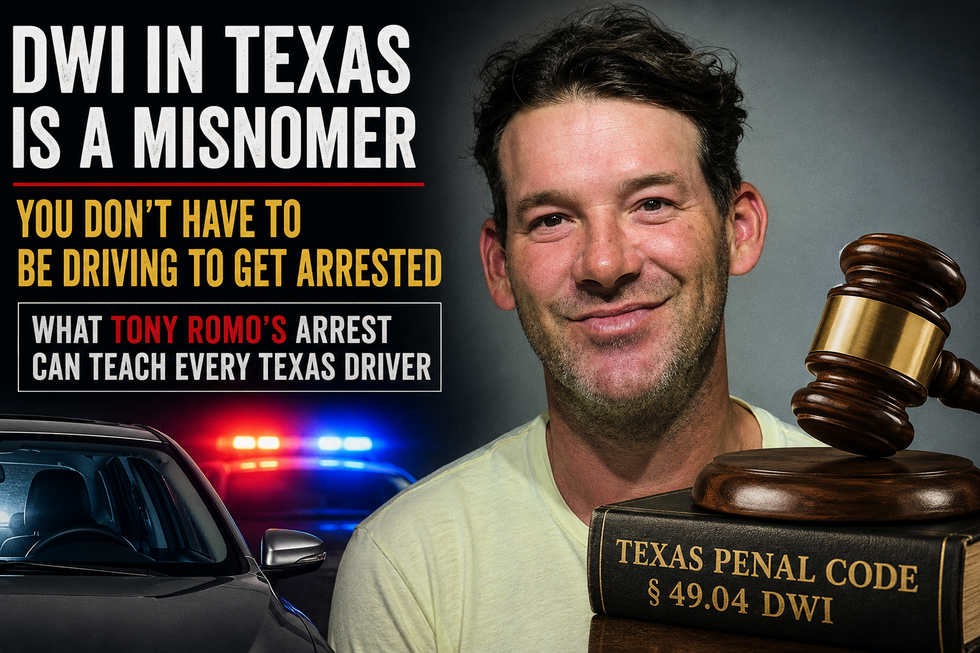
Tony Romo's Arrest Is Making Headlines. It Also Reveals One of the Biggest Misunderstandings About Texas DWI Law.
For nearly fourteen seasons, Tony Romo was the face of the Dallas Cowboys. Today, millions know him as one of the NFL's most recognizable broadcasters. His career has been built on making split-second decisions under pressure.
Yet recently, Romo found himself in a situation that can happen to anyone.
According to law enforcement, Romo was arrested in Wisconsin on suspicion of Operating While Intoxicated (OWI) after deputies allegedly observed signs of intoxication during a traffic stop. As with every criminal case, the allegations remain just that—allegations—and Mr. Romo is presumed innocent unless and until proven guilty in court.
For most people, the story quickly became another celebrity arrest.
For criminal defense lawyers, however, it highlights something much more important.
Wisconsin's law may actually be named more accurately than Texas's.
Because while Texans commonly call the offense Driving While Intoxicated, Texas law doesn't actually require someone to be "driving" at all.
Instead, the law prohibits operating a motor vehicle while intoxicated.
That difference may sound minor.
Legally, it can mean everything.
Why Wisconsin Calls It "Operating While Intoxicated"
Wisconsin doesn't use the term DUI or DWI.
Instead, the offense is called Operating While Intoxicated, or OWI.
At first glance, it may seem like different states simply use different terminology.
But Wisconsin's wording actually reflects an important legal concept that Texas follows as well.
Despite calling the offense Driving While Intoxicated, Texas law is written around operating a motor vehicle.
That's a distinction many Texans don't discover until after they're arrested.
Texas Law Never Says You Must Be Driving
The Texas DWI statute makes it illegal to be intoxicated while operating a motor vehicle in a public place.
Notice what's missing.
The Legislature did not choose the word driving.
Instead, prosecutors only have to prove that someone was operating the vehicle.
That single word dramatically expands the situations where someone can be arrested.
Most people assume that if their car never moved, they cannot receive a DWI.
Unfortunately, that's simply not true.
The Biggest DWI Myth in Texas
Ask almost anyone what it takes to get arrested for DWI.
Most will answer something like:
"You have to be driving."
That answer is understandable.
After all, the offense itself literally says Driving While Intoxicated.
But courts across Texas have repeatedly recognized that operation can exist even when a vehicle never travels down the roadway.
Movement is certainly strong evidence of operation.
It is not always required.
What Does "Operating" Actually Mean?
Unlike many criminal statutes, Texas law never gives a simple definition of "operate."
Instead, appellate courts have interpreted the word over many years.
Generally speaking, someone operates a motor vehicle when they take actions that enable the vehicle to function or place it in a position where it can be used.
Every case depends on its specific facts.
There is no checklist.
Instead, prosecutors often look at the totality of the circumstances.
Some of the evidence they commonly rely upon includes:
-
Whether the engine was running
-
Whether the keys were in the ignition
-
Whether the vehicle was in gear
-
Whether the person was seated behind the steering wheel
-
Whether lights or other vehicle controls were activated
-
Whether officers observed recent movement
-
Statements made by the driver
-
Witness testimony
-
Body camera footage
-
Surveillance video
No single factor automatically determines whether someone was operating.
That is one reason experienced DWI lawyers spend significant time investigating exactly what officers observed—and what they did not.
The Situation That Surprises Almost Everyone
Imagine this scenario.
You leave a Cowboys game.
You realize you've had too much to drink.
You make what feels like the responsible decision.
Instead of driving home, you pull into a parking lot.
You leave the engine running so the air conditioning continues working in the Texas heat.
You recline your seat.
You fall asleep.
Hours later, flashing lights wake you up.
You've just been arrested for DWI.
Many people believe that because they never drove anywhere, they cannot be charged.
Unfortunately, prosecutors may see things differently.
Again, every case depends on its facts.
But simply being parked does not automatically prevent a DWI arrest.
The Same Decision Could Face Thousands of Texans Every Weekend
This is one reason Tony Romo's arrest resonates beyond celebrity news.
Most Texans won't find themselves on national television.
But thousands will leave concerts, sporting events, weddings, restaurants, bars, festivals, and holiday celebrations believing they have avoided a DWI simply because they never started driving.
Some choose to "sleep it off."
Some wait for a rideshare.
Some sit in the driver's seat while making phone calls.
Some start the engine only to run the heater or air conditioner.
Many of those people genuinely believe they're doing the safest thing possible.
Yet depending on the circumstances, those same decisions can still lead to an arrest.
Why These Cases Are Often More Complicated Than People Realize
Because Texas focuses on operation, DWI cases frequently involve complicated legal questions.
Defense attorneys often investigate issues such as:
Was the person actually operating the vehicle?
Simply sitting inside a car is not automatically enough.
The surrounding facts matter.
What exactly did the officer observe?
Police reports sometimes summarize observations in broad conclusions.
Body camera footage can tell a different story.
Was there reasonable suspicion for the encounter?
Many DWI investigations begin long before field sobriety tests.
If officers lacked legal justification to approach or detain someone, important evidence may be challenged.
Was there probable cause to arrest?
Not every interaction with an intoxicated person justifies a DWI arrest.
The officer still must establish probable cause under the law.
Were field sobriety tests administered correctly?
These tests involve standardized procedures.
Mistakes happen.
Medical conditions, fatigue, injuries, weather, footwear, age, and anxiety can all affect performance.
Were breath or blood tests legally obtained?
Chemical testing often becomes one of the most heavily litigated issues in DWI cases.
Celebrity Cases Often Remind Us That No One Is Immune
Every time a public figure is arrested, headlines spread across the country.
We've seen professional athletes.
Actors.
Musicians.
Business executives.
Doctors.
Judges.
Police officers.
Now, one of Dallas's most beloved former quarterbacks.
The lesson isn't that celebrities make mistakes.
The lesson is that DWI allegations don't discriminate.
They affect successful professionals.
Parents.
College students.
Teachers.
Veterans.
Small business owners.
First-time offenders with spotless records.
One unexpected evening can suddenly place someone's career, driver's license, finances, and reputation at risk.
Don't Assume the State Can Prove Its Case
One of the biggest mistakes people make after a DWI arrest is assuming conviction is inevitable.
It isn't.
Every DWI prosecution requires the government to prove every element of the offense beyond a reasonable doubt.
That includes proving intoxication.
And proving operation.
Those are often much more complicated questions than the headlines suggest.
An experienced criminal defense lawyer may uncover legal issues involving:
-
Unlawful traffic stops
-
Constitutional violations
-
Improper police procedures
-
Weak evidence of operation
-
Faulty field sobriety testing
-
Problems with breath testing
-
Blood testing errors
-
Inconsistent witness statements
-
Missing body camera footage
-
Alternative explanations for observed behavior
Each case deserves an individualized defense strategy.
If You've Been Arrested for DWI, Get Legal Help Immediately
Tony Romo's case will ultimately be decided in court—not in newspaper headlines or social media comments.
The same is true for every person arrested for DWI.
If you or someone you love has been charged with DWI in Dallas, Fort Worth, Plano, Frisco, McKinney, Denton, Arlington, or anywhere in North Texas, don't assume the case against you is straightforward simply because you were found inside a vehicle.
Remember:
In Texas, the issue often isn't whether you were driving.
It's whether the State can prove you were operating a motor vehicle while intoxicated.
That distinction has changed the outcome of countless DWI cases.
At Texas Defenders, we aggressively investigate every aspect of a DWI arrest—from the initial police contact to the scientific evidence—and fight to protect our clients' freedom, driver's licenses, careers, and futures.
If you've been arrested for DWI, call Texas Defenders at 214-306-9696 or visit TexasDefenders.com to schedule a confidential consultation. Our attorneys represent clients throughout Dallas County, Tarrant County, Collin County, Denton County, and surrounding communities.
Frequently Asked Questions
Can you get a DWI in Texas if your car never moved?
Yes. Texas law prohibits operating a motor vehicle while intoxicated. Depending on the facts, prosecutors may argue that a person was operating a vehicle even if it never traveled down the road.
Is sitting in a parked car enough for a DWI?
Not automatically. Every case depends on its specific facts, including whether the engine was running, where the person was located, whether the vehicle was capable of being driven, and other surrounding circumstances.
Why is it called DWI if you don't have to be driving?
The name is somewhat misleading. Texas law uses the term "Driving While Intoxicated," but the actual statute criminalizes operating a motor vehicle while intoxicated.
What is the difference between "driving" and "operating"?
Driving generally refers to moving a vehicle, while operating is a broader legal concept that can include exercising control over a vehicle in ways that do not necessarily involve movement.
Should I hire a lawyer if I wasn't actually driving?
Absolutely. Whether you were legally operating a motor vehicle is often one of the most important issues in a Texas DWI case and may significantly affect the outcome of your defense.







Comments
There are no comments for this post. Be the first and Add your Comment below.
Leave a Comment