
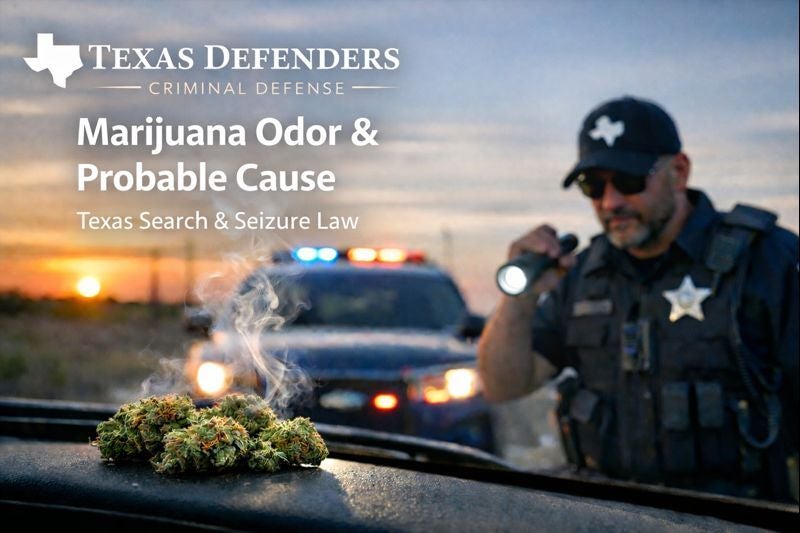
For decades, Texas law enforcement officers have relied on one simple claim to justify searches: “I smelled marijuana.” But as marijuana laws continue to evolve across the country, many Texans are asking an important question: does the odor of marijuana or a weed smell still provide probable cause for a search in Texas?
The answer is not as straightforward as it once was—and in many cases, that gray area creates opportunities for criminal defense attorneys to challenge illegal searches.
What Is Probable Cause?
Probable cause is a constitutional standard under the Fourth Amendment that requires police to have specific, articulable facts suggesting a crime has been committed before conducting a search. It is more than a hunch, but less than proof beyond a reasonable doubt.
Historically, Texas courts accepted the odor of marijuana—alone—as enough to establish probable cause to search a vehicle or person. However, changes in hemp laws, marijuana enforcement practices, and court scrutiny have complicated that analysis.
Marijuana vs. Hemp: Why the Smell Matters Less Than It Used To
In 2019, Texas legalized hemp containing less than 0.3% THC. Hemp and marijuana are visually and olfactorily indistinguishable. They smell exactly the same.
This distinction has created a major legal problem for law enforcement. If the odor could be hemp—which is legal—then the smell alone may no longer automatically indicate criminal activity.
Defense attorneys now regularly argue that the odor of marijuana does not reliably establish probable cause, because officers cannot differentiate legal hemp from illegal marijuana by smell alone.
Courts across Texas are increasingly forced to confront this reality.
What Texas Courts Say About Marijuana Odor
Texas courts have not issued a blanket rule eliminating odor-based probable cause, but they have become more skeptical—especially when odor is the only justification for a search.
The Texas Court of Criminal Appeals has repeatedly emphasized that probable cause must be based on the totality of the circumstances, not a single factor taken in isolation.
That means odor alone may not be enough when:
-
No marijuana is visible
-
No admissions are made
-
No other illegal behavior is observed
-
The stop itself was questionable
In real cases, judges increasingly scrutinize whether an officer's claim of odor is credible or simply a convenient excuse after the fact.
Vehicle Searches vs. Person Searches
It is important to understand the difference between searching a vehicle and searching a person.
-
Vehicle searches: Courts have historically given officers more leeway due to the “automobile exception.” Even so, odor alone is becoming easier to challenge post-hemp legalization.
-
Person searches: The smell of marijuana generally does not justify searching someone's pockets or body without additional evidence.
If police escalate from a traffic stop to a full search of your person based solely on odor, that search is often legally vulnerable.
The Reality: “I Smell Marijuana” Is Often Challenged Successfully
In practice, the claim of marijuana odor is one of the most commonly litigated issues in Texas drug cases. Officers know it is difficult to disprove, but judges also know it is frequently overused.
At Texas Defenders, we regularly challenge:
-
Vague or inconsistent odor testimony
-
Reports that suddenly mention odor only after drugs are found
-
Claims unsupported by body camera footage
-
Stops that began for minor traffic violations and escalated without justification
When courts determine a search lacked probable cause, the result can be suppression of evidence—often leading to dismissals.
Can Marijuana Odor Justify a DWI or Drug Arrest?
Odor alone does not prove intoxication, possession, or impairment. Yet officers sometimes use marijuana smell to justify:
-
Field sobriety tests
-
Vehicle searches
-
Arrests for possession of controlled substances
Each of these actions must still comply with constitutional protections. If police stretch the odor claim beyond its legal limits, it opens the door for suppression motions.
Why This Matters If You Were Arrested in North Texas
Many marijuana, PCS, and DWI cases in Dallas County, Collin County, Denton County, and Tarrant County begin with a traffic stop and an odor claim. What happens in the first few minutes of police contact often determines whether a case survives.
If your case is based on an odor-only search, it is critical to have an experienced Texas criminal defense attorney review:
-
The stop
-
The search
-
The officer's report
-
Body camera footage
-
Whether probable cause actually existed
Speak With a Texas Criminal Defense Lawyer
The law surrounding marijuana odor and probable cause is evolving—and that evolution benefits defendants who know how to challenge unlawful searches.
If you were searched or arrested based on the alleged odor of marijuana, do not assume the police acted legally.
📞 Call Texas Defenders at 214-306-9696
📍 3302 Swiss Circle, Dallas, TX 75204
We defend clients throughout Dallas County, Tarrant County, Collin County, Denton County, and surrounding areas. A search that starts unlawfully can end with a dismissal—but only if it is challenged correctly.







Comments
There are no comments for this post. Be the first and Add your Comment below.
Leave a Comment