
Dallas Police Are Increasing Freeway Patrols: What Drivers Need to Know About Traffic Stops, DWI Arrests, Drug Charges, and Their Rights
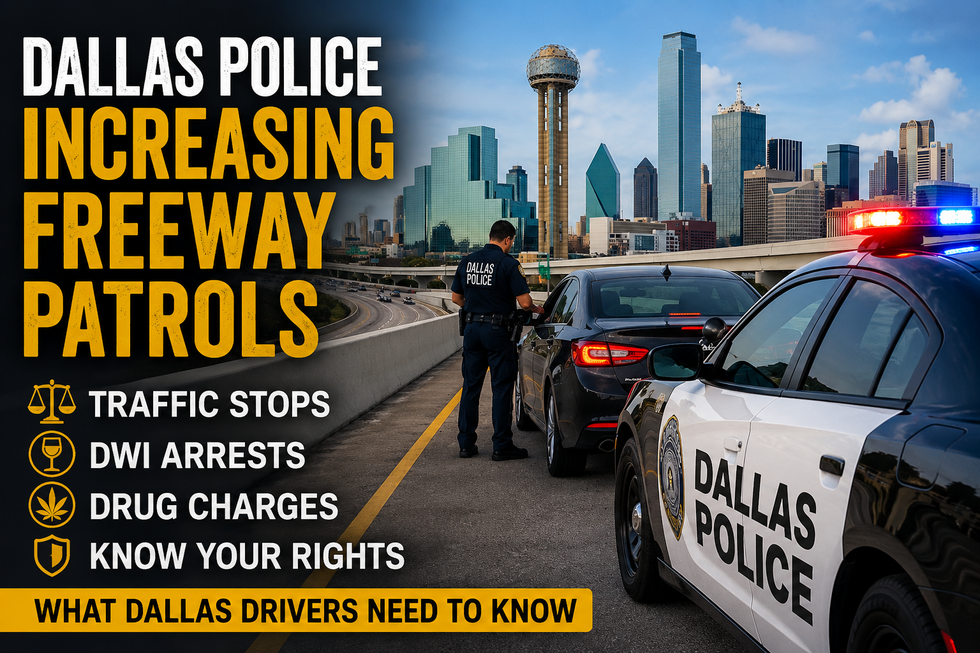
A major change is happening on Dallas highways, and every driver in North Texas should understand what it could mean.
Beginning August 28, 2026, the Dallas Police Department is assuming responsibility for freeway traffic enforcement and crash response throughout the City of Dallas. DPD has increased staffing in its Traffic Unit and says those officers will not simply respond to wrecks—they will also conduct proactive traffic enforcement and target dangerous driving behavior.
Beginning September 1, Dallas Police will further expand those responsibilities onto North Texas Tollway Authority roadways located within Dallas city limits, including portions of the President George Bush Turnpike.
For years, many Dallas drivers were accustomed to seeing Dallas County Sheriff's deputies or Texas Department of Public Safety troopers handling enforcement on certain freeways and toll roads. That is changing.
Dallas Police officers are going to have a substantially larger presence on Dallas highways.
And drivers need to understand something important:
A traffic stop does not always end with a traffic ticket.
Some of the most serious criminal cases we handle at Texas Defenders begin with something as ordinary as speeding, failing to signal, drifting across a lane marker, having an expired registration, or allegedly committing another traffic violation.
The officer approaches the vehicle.
The officer begins asking questions.
The officer claims to smell alcohol, marijuana, or another substance.
The officer notices something inside the vehicle.
The officer asks the driver to step outside.
And suddenly a traffic stop has become a criminal investigation.
That investigation can potentially result in charges involving DWI, controlled substances, marijuana or THC products, unlawfully carrying a weapon, warrants, evading arrest, or other offenses.
With Dallas Police expanding freeway enforcement, drivers should understand both the rules of the road and their constitutional rights when those flashing lights appear behind them.
Why Dallas Police Are Taking Over More Freeway Patrols
According to the Dallas Police Department, the department expanded its Traffic Unit after the Dallas County Highway Traffic Program agreement ended on August 28, 2026.
That arrangement had involved the Dallas County Sheriff's Office providing freeway traffic enforcement and crash-response services within Dallas.
DPD says its expanded Traffic Unit will now focus on:
-
Responding to and investigating crashes;
-
Proactive traffic enforcement;
-
Addressing dangerous driving behavior;
-
Supporting traffic management during major incidents; and
-
Providing dedicated traffic-safety resources on Dallas freeways and tollways.
The Dallas Morning News reported that Dallas officers had already begun patrolling highways previously handled by sheriff's deputies as the transition approached.
The practical takeaway for Dallas motorists is simple:
Expect to see more Dallas Police officers actively working Dallas freeways.
And DPD's own announcement specifically uses the phrase “proactive traffic enforcement.”
That matters.
Traffic enforcement means traffic stops. And traffic stops frequently become the starting point for criminal investigations.
Which Dallas Roads Could Be Affected?
The change concerns freeways within Dallas city limits and NTTA roadways located within the city.
That means motorists traveling major Dallas highway corridors should become accustomed to seeing Dallas Police officers performing enforcement functions that motorists may previously have associated with sheriff's deputies or DPS troopers.
The change is particularly significant because Dallas is surrounded by a massive network of heavily traveled highways connecting Dallas with communities throughout North Texas.
Drivers routinely travel into and through Dallas from Plano, Frisco, McKinney, Richardson, Garland, Irving, Mesquite, Carrollton, Addison, Farmers Branch, Duncanville, DeSoto, Cedar Hill, Grand Prairie and surrounding communities.
A person does not have to live in Dallas to find themselves facing a Dallas criminal case arising from a freeway traffic stop.
The Most Important Thing to Remember: A Traffic Stop Is an Investigation
Most people think about being pulled over this way:
Officer sees traffic violation → officer writes ticket → driver leaves.
But that is only one possible outcome.
Police officers are trained investigators.
During the encounter, an officer may be observing virtually everything happening around the vehicle.
That can include the driver's speech, movements, coordination, eyes, responses to questions, odors coming from the vehicle, containers inside the passenger compartment, statements made by passengers, and objects visible through the windows.
The officer may also begin asking questions designed to investigate matters that go far beyond the original traffic violation.
“Where are you coming from?”
“Where are you going?”
“Have you been drinking?”
“When was your last drink?”
“Is there anything illegal in the vehicle?”
“Do you have any marijuana?”
“Do you have any weapons?”
“Can I take a look inside?”
Drivers frequently believe they have to answer every question.
They do not.
There is an enormous difference between cooperating with lawful instructions during a traffic stop and voluntarily providing evidence that may later be used against you.
What Should You Do When Dallas Police Pull You Over?
If you see emergency lights behind you, do not panic.
Signal and safely move to an appropriate location as soon as reasonably possible. On a freeway, safety matters. Do not make sudden or dangerous movements simply because an officer has activated emergency equipment.
Once stopped, remain calm.
Keep your hands visible and avoid unnecessary movements around the passenger compartment.
Be respectful.
Do not argue with the officer on the side of the highway.
And most importantly:
Do not try to litigate the legality of the stop on the shoulder of I-35, I-30, I-45, US-75, I-635, the Dallas North Tollway, or another Dallas roadway.
If the officer made an unlawful stop, your criminal defense attorney can challenge it later.
The side of the highway is not the courtroom.
Provide Required Identification—but Do Not Lie
Drivers should understand that refusing required identifying information is different from declining to answer investigative questions.
Texas law contains specific identification requirements applicable to motorists during lawful detentions. Providing false identifying information can also create an entirely separate criminal problem.
Do not give police a fake name.
Do not provide false identifying information.
Do not hand over somebody else's driver's license.
And do not turn a traffic stop into a new criminal allegation by lying about your identity.
But identifying yourself does not mean you need to explain where you spent the evening, what you consumed, what is inside your vehicle, or answer every investigative question an officer asks.
You Do Not Have to Talk Your Way Out of an Arrest
This is one of the biggest mistakes people make.
They think:
“If I explain everything, the officer will understand.”
Sometimes the explanation becomes the evidence.
Consider a driver who is asked:
“Have you had anything to drink tonight?”
The driver says:
“Only two beers.”
The driver believes that answer is helpful.
The prosecutor may later view it as an admission that the driver consumed alcohol before operating the vehicle.
Or imagine an officer asks:
“Is that your backpack?”
The driver says yes.
Police later discover contraband inside.
The ownership statement may suddenly become important evidence in a possession case.
You should never lie to law enforcement.
But you generally do not need to volunteer potentially incriminating information.
A polite statement that you do not wish to answer questions is very different from arguing, resisting, or providing false information.
If Police Ask to Search Your Car
One of the most important questions a driver can hear during a traffic stop is:
“Do you mind if I search your vehicle?”
Pay attention to the wording.
If an officer is asking for permission, you should understand that you do not have to voluntarily consent.
You can calmly say:
“I do not consent to any searches.”
That does not necessarily mean police cannot search the vehicle.
Police may claim another legal justification exists for a search.
But there is an important difference between police conducting a search based on claimed legal authority and a driver voluntarily agreeing to the search.
Texas law-enforcement agencies are specifically required to record information about whether searches occurred during motor-vehicle stops and whether the detained person consented to the search.
Do not physically interfere with a search.
Do not fight with an officer.
Do not attempt to hide or destroy evidence.
Simply make your lack of consent clear and allow your attorney to challenge the legality of the search later if appropriate.
Do Not Reach for, Hide, or Throw Anything
Police may interpret sudden movements as a safety threat or as an attempt to conceal evidence.
If there is something in the vehicle you are worried about, reaching for it almost always makes the situation worse.
Do not throw something out the window.
Do not shove something underneath the seat.
Do not hand an object to a passenger.
Do not delete something from your phone while an officer is standing at the window.
Do not attempt to conceal evidence.
Remain calm and let your attorney address the legal issues afterward.
Never Run From a Traffic Stop
A traffic citation is manageable.
An evading case can be far more serious.
If an officer activates emergency lights, attempting to outrun police can transform the entire situation.
Texas has separate criminal laws addressing evading arrest or detention, and the consequences can become significantly more serious depending on how the alleged evasion occurs.
Even if you believe the officer has no legitimate reason to stop you, fleeing is generally not the way to challenge the stop.
Pull over safely.
Exercise your rights.
Call a criminal defense lawyer afterward.
How a Simple Dallas Traffic Stop Can Become a DWI Arrest
DWI is one of the most common criminal investigations arising from traffic stops.
Under Texas Penal Code §49.04, a person commits DWI if the person is intoxicated while operating a motor vehicle in a public place.
Notice the statute does not simply say “driving.”
It says operating.
That distinction can become important in Texas DWI cases.
A DWI investigation may begin after allegations involving:
-
Speeding;
-
Driving too slowly;
-
Drifting between lanes;
-
Failing to maintain a single lane;
-
Running a red light;
-
Failing to signal;
-
Driving without headlights;
-
A collision;
-
Stopping somewhere an officer considers unusual; or
-
Other allegedly unsafe driving behavior.
After approaching the vehicle, the officer may claim to observe signs associated with intoxication.
The officer may then ask the driver to exit the vehicle and perform standardized field sobriety tests.
At that point, what began as a traffic stop has become a DWI investigation.
What If the Officer Asks You to Perform Field Sobriety Tests?
Many drivers believe roadside sobriety exercises are simply something everyone is legally required to complete.
The reality is more complicated.
If an officer asks you to perform roadside tests, understand that the officer may already be collecting evidence for a possible DWI arrest.
These tests may include the horizontal gaze nystagmus test, walk-and-turn test, and one-leg-stand test.
Performance can be affected by many factors unrelated to intoxication, including road conditions, footwear, injuries, age, fatigue, nervousness, weather, traffic, and how the test was explained or administered.
If you are arrested for DWI, the details of the roadside investigation can become critically important.
Video from body-worn cameras and patrol vehicles may tell a very different story from the officer's written report.
Breath and Blood Testing Can Become Major Evidence
A Dallas DWI investigation may eventually involve a request for a breath or blood specimen.
These issues can implicate both the criminal DWI case and separate driver's-license consequences.
Blood evidence in particular can involve complicated questions about warrants, collection procedures, chain of custody, laboratory testing, retrograde extrapolation, contamination, and interpretation.
Do not assume that because the government has a blood or breath number the DWI case is automatically proven.
The evidence still needs to be examined.
Drug Possession Cases Frequently Begin With Traffic Stops
Some of the most serious criminal charges arising from traffic stops involve controlled substances.
The officer may claim to smell something.
Contraband may allegedly be visible.
A driver may consent to a search.
Police may claim probable cause.
A passenger may make a statement.
Or officers may conduct a search following an arrest.
Suddenly the driver or passenger is facing a controlled-substance case.
Depending on the substance and amount involved, Texas drug-possession charges can range from misdemeanors to serious felonies.
For example, possession of less than one gram of a Penalty Group 1 or 1-B controlled substance is generally a state jail felony under Texas law.
That means a traffic stop over something seemingly insignificant can ultimately expose someone to a felony prosecution.
Marijuana, THC, Delta-8, and Hemp Products Can Create Additional Problems
Texas law involving marijuana, hemp-derived cannabinoids, THC products, Delta-8 and other substances has become increasingly complicated.
Products people purchased legally—or believed were legal—can become a major issue during a vehicle search.
Packaging, labeling, laboratory analysis, THC concentration, the particular cannabinoid involved, and when and where the product was purchased may all become relevant.
Do not assume that telling the officer, “I bought it legally,” ends the investigation.
And do not assume that because a product came from a smoke shop or retail store police cannot arrest you.
If you are arrested over a THC, marijuana, vape, edible, or cannabinoid product, preserve the packaging and purchase information when possible and contact a criminal defense lawyer.
Weapons Charges Can Also Arise During Traffic Stops
Texas has broad firearm rights, but that does not mean every person can legally possess or carry every firearm in every circumstance.
A weapon discovered during a traffic stop can create complicated questions involving:
-
The person's age;
-
Prior criminal history;
-
Whether the person is legally prohibited from possessing a firearm;
-
Whether other alleged criminal activity is occurring;
-
How the weapon is carried;
-
Whether the firearm is in plain view;
-
Where the vehicle is located; and
-
Other circumstances surrounding possession.
Texas Penal Code §46.02 specifically addresses circumstances involving handguns carried in motor vehicles.
A driver should not assume that simply because Texas allows many people to carry firearms, a weapon can never become the basis for a criminal charge.
Open Containers Can Turn a Traffic Stop Into a Bigger Investigation
Texas also prohibits possessing an open container of alcohol in the passenger area of a motor vehicle located on a public highway, subject to statutory exceptions.
An open container may also attract additional attention during a DWI investigation.
A driver stopped for speeding who has an open beer can sitting in a cupholder may quickly find the officer asking considerably more questions than would otherwise occur during an ordinary speeding stop.
Outstanding Warrants Can Surface During Routine Stops
Another common way a traffic stop becomes an arrest has nothing to do with what is happening inside the vehicle.
The officer runs the driver's information.
A warrant appears.
The driver is arrested.
People are sometimes unaware that a warrant exists, particularly when it involves an older municipal case, missed court date, unresolved citation, or other matter.
That is another reason seemingly insignificant traffic stops can have unexpected consequences.
False Identification Can Make Things Worse
If you have a warrant, lying about your identity is not a solution.
Texas Penal Code §38.02 addresses failure to identify and providing false or fictitious identifying information in certain circumstances.
Police databases and electronic records make false identification an especially dangerous strategy.
You may turn one legal problem into two.
What If There Are Drugs or Contraband in a Passenger's Bag?
Vehicle possession cases are frequently more complicated than police reports make them appear.
Suppose four people are traveling together.
Police search the vehicle and find drugs.
Who possessed them?
The driver?
The person sitting closest to them?
The owner of the vehicle?
The owner of the bag?
Everyone?
Possession generally involves questions of knowledge and control. Simply being near contraband does not automatically resolve those issues.
These cases can involve what Texas courts often refer to as affirmative links connecting a particular defendant to the contraband.
Statements made during the traffic stop may become extremely important.
That is another reason people should be careful about trying to explain their way out of the situation.
Passengers Should Also Understand Their Rights
Drivers are not the only people affected by traffic stops.
Passengers may also find themselves questioned by police.
An officer may ask:
“Whose bag is this?”
“Do you have anything illegal?”
“Where are you coming from?”
“Who owns that?”
“Can I search your backpack?”
Again, do not lie.
But understand the difference between complying with lawful police commands and voluntarily answering questions or consenting to a search.
Can Police Search Your Phone During a Traffic Stop?
Phones contain enormous amounts of personal information: text messages, photographs, location information, social media accounts, emails, banking information, browsing history and more.
Do not assume that a traffic stop automatically gives police unrestricted access to your phone.
The legality of a phone search depends heavily on the circumstances, including whether consent was given or a warrant or another recognized legal basis exists.
If police ask for permission to search your phone, you can clearly state that you do not consent.
Again, do not physically interfere if officers seize the device.
Let your attorney litigate the issue.
The Four Sentences Dallas Drivers Should Remember
If you remember nothing else from this article, remember these principles:
“I will comply with your lawful instructions.”
“I do not wish to answer questions.”
“I do not consent to any searches.”
“I would like to speak with a lawyer.”
You do not need to scream them.
You do not need to argue.
You do not need to lecture the officer about constitutional law.
Calm, respectful and clear is usually far better than confrontational.
What Not to Say During a DWI Stop
Drivers often volunteer statements they believe will help but that prosecutors may later use as evidence.
Examples include:
“I only had two drinks.”
“I stopped drinking an hour ago.”
“I know I'm probably over.”
“I shouldn't have driven.”
“I'm coming from a bar.”
“I smoked earlier, but I'm fine now.”
“That weed isn't mine, but I knew it was there.”
“I took my prescription, but it makes me sleepy.”
The exact legal significance of any statement depends on the circumstances.
The broader point is simple:
You cannot talk your way out of every investigation, but you can absolutely talk your way into evidence being used against you.
What Should You Do After You Are Arrested?
Once you are arrested, the priorities change.
Do not try to convince the officer to release you.
Do not discuss the facts of the case with other people in the jail.
Do not assume telephone calls are private.
Do not post your version of events on Instagram, TikTok, Facebook, X, Reddit or another social platform.
Do not contact witnesses and ask them to change their stories.
Do not destroy evidence.
Contact an experienced Dallas criminal defense attorney as soon as possible.
The sooner the defense begins investigating, the better the opportunity may be to identify and preserve evidence.
Why Acting Quickly After a Traffic-Stop Arrest Matters
Evidence does not always remain available forever.
Depending on the case, a defense attorney may need to investigate:
-
Officer body-camera footage;
-
Dash-camera footage;
-
Dispatch and CAD records;
-
911 recordings;
-
Traffic cameras;
-
Nearby surveillance cameras;
-
Tollway records;
-
Witnesses;
-
Photographs;
-
Vehicle data;
-
Blood-testing records;
-
Laboratory documentation;
-
Search warrants;
-
Police reports; and
-
The legal justification for the initial traffic stop.
A criminal case arising from a traffic stop should be examined from the very beginning.
The first question should often be:
Why was the vehicle stopped in the first place?
The Initial Traffic Stop Can Be Critical to the Entire Criminal Case
Police generally need a lawful basis to detain a vehicle.
That makes the officer's claimed reason for the initial stop extremely important.
Was the driver actually speeding?
Did the driver actually cross a lane marker?
Was the license plate really obscured?
Did the officer misunderstand the traffic law?
Does video support the officer's version?
Did the officer observe the alleged violation personally?
Was the detention extended beyond what was legally justified?
Was the subsequent search lawful?
Was consent actually given?
These questions matter because evidence obtained following an unlawful detention or search may potentially become the subject of a motion to suppress.
In other words, the traffic violation is not merely background information.
It may be one of the most important parts of the entire defense.
Why Hire Texas Defenders After a Dallas Traffic-Stop Arrest?
When a traffic stop becomes a criminal case, you need lawyers who understand that the defense begins long before the prosecutor walks into a courtroom.
At Texas Defenders, we represent people accused of crimes throughout Dallas and North Texas, including cases arising from traffic stops on Dallas freeways, tollways, city streets and surrounding highways.
Our criminal defense attorneys handle cases involving allegations such as:
-
DWI;
-
Drug possession;
-
THC and marijuana offenses;
-
Controlled-substance charges;
-
Weapons offenses;
-
Evading arrest;
-
Assault;
-
Theft;
-
Probation violations;
-
Warrants; and
-
Other misdemeanor and felony charges.
We examine not just what police claim they found, but how they got there.
Why did the officer stop the vehicle?
How long did the detention last?
What did the body camera show?
Did the officer have legal justification to expand the investigation?
Was consent to search actually given?
Was there probable cause?
Were statements obtained lawfully?
Was the evidence properly collected?
Does the physical evidence actually connect our client to the alleged offense?
Those questions can make the difference between simply accepting the police narrative and building an actual defense.
Local Experience Matters in Dallas Criminal Cases
Criminal defense is local.
A Dallas DWI case is not merely a “Texas DWI case.” It moves through local courts, prosecutors, judges, bond procedures and law-enforcement agencies.
Texas Defenders represents clients throughout Dallas County and across North Texas, including Dallas, Fort Worth, Plano, Frisco, McKinney, Denton, Richardson, Garland, Irving, Mesquite, Carrollton, Addison, Farmers Branch, Duncanville, DeSoto, Cedar Hill and surrounding communities.
Our attorneys regularly defend cases in Dallas County, Collin County, Tarrant County and Denton County.
When your freedom, driver's license, employment and future may be at stake, having a defense team familiar with the North Texas criminal justice system matters.
Dallas Drivers Should Expect More Police Presence on the Highways
The expanded Dallas Police Traffic Unit represents a significant change in freeway enforcement.
DPD says dedicated traffic personnel will respond to crashes, conduct proactive enforcement and target dangerous driving behavior on Dallas freeways. Starting September 1, that responsibility expands further to NTTA roads within Dallas city limits.
That does not mean every driver should be afraid of being stopped.
But it does mean drivers should be prepared.
Know your rights.
Keep your registration and insurance current.
Obey traffic laws.
Do not drive while intoxicated.
Do not flee.
Do not lie to police.
Do not voluntarily consent to searches simply because you feel pressured.
And do not assume a traffic stop is insignificant simply because it began with a minor violation.
Pulled Over and Arrested in Dallas? Call Texas Defenders
If a Dallas traffic stop has turned into a DWI arrest, drug charge, THC case, weapons allegation, evading case, warrant arrest or another criminal accusation, the decisions you make immediately afterward can matter.
Texas Defenders is ready to investigate the stop, the search, the arrest and the evidence.
Our Dallas criminal defense lawyers represent clients throughout Dallas County and across North Texas.
Texas Defenders
3302 Swiss Circle
Dallas, Texas 75204
214-306-9696
The government has police officers, investigators and prosecutors working on its side.
You should have a defense team working on yours.
Call Texas Defenders at 214-306-9696 to discuss your case.
This article is provided for general educational purposes and does not constitute legal advice. Every traffic stop and criminal case depends on its specific facts and circumstances.
Suggested Internal Links
For maximum SEO value, I recommend internally linking natural anchor text in this article to existing Texas Defenders pages for:
Dallas DWI lawyer → DWI practice page
Dallas criminal defense attorney → Dallas criminal defense page
drug possession charges in Texas → drug crimes page
THC and marijuana offenses → relevant THC/marijuana content
weapons offenses → weapons/gun charges page
evading arrest → evading arrest page
traffic stops on the Dallas North Tollway → existing Tollway article
field sobriety tests → DWI/FST content
blood and breath testing → DWI testing content
motion to suppress → search-and-seizure or criminal-defense content
Suggested FAQ Schema Questions
Are Dallas Police now patrolling Dallas freeways?
Yes. Beginning August 28, 2026, the Dallas Police Department expanded its Traffic Unit to assume freeway traffic enforcement and crash-response responsibilities within Dallas city limits. DPD also announced that it would assume primary responsibilities on NTTA roadways within Dallas beginning September 1.
Can a traffic stop in Dallas lead to a DWI arrest?
Yes. A traffic stop for speeding, lane issues, signaling violations or other alleged traffic offenses can develop into a DWI investigation if an officer believes there are signs of intoxication.
Do I have to consent to a vehicle search during a Texas traffic stop?
Not merely because an officer asks for permission. A driver can state that they do not consent to a search. Police may nevertheless conduct a search if they claim another lawful basis exists, and the legality of that search can later be challenged in court.
Should I answer questions about drinking during a traffic stop?
Drivers should comply with lawful requirements but should understand that statements made during a traffic stop can potentially be used as evidence. You should not lie to an officer, but you can decline to answer potentially incriminating investigative questions.
What should I say if Dallas Police ask to search my car?
You can calmly state, “I do not consent to any searches.” Do not physically interfere with officers if they proceed with a search.
Can a Dallas traffic stop lead to a felony drug charge?
Yes. A traffic stop can develop into a vehicle search and controlled-substance investigation. Some Texas controlled-substance possession offenses are felonies even when the alleged amount is relatively small.
What should I do after being arrested during a Dallas traffic stop?
Avoid discussing the facts of your case with other people or posting about the arrest online. Contact a criminal defense attorney promptly so the defense can evaluate the legality of the stop, detention, search and arrest and begin preserving relevant evidence.







Comments
There are no comments for this post. Be the first and Add your Comment below.
Leave a Comment