
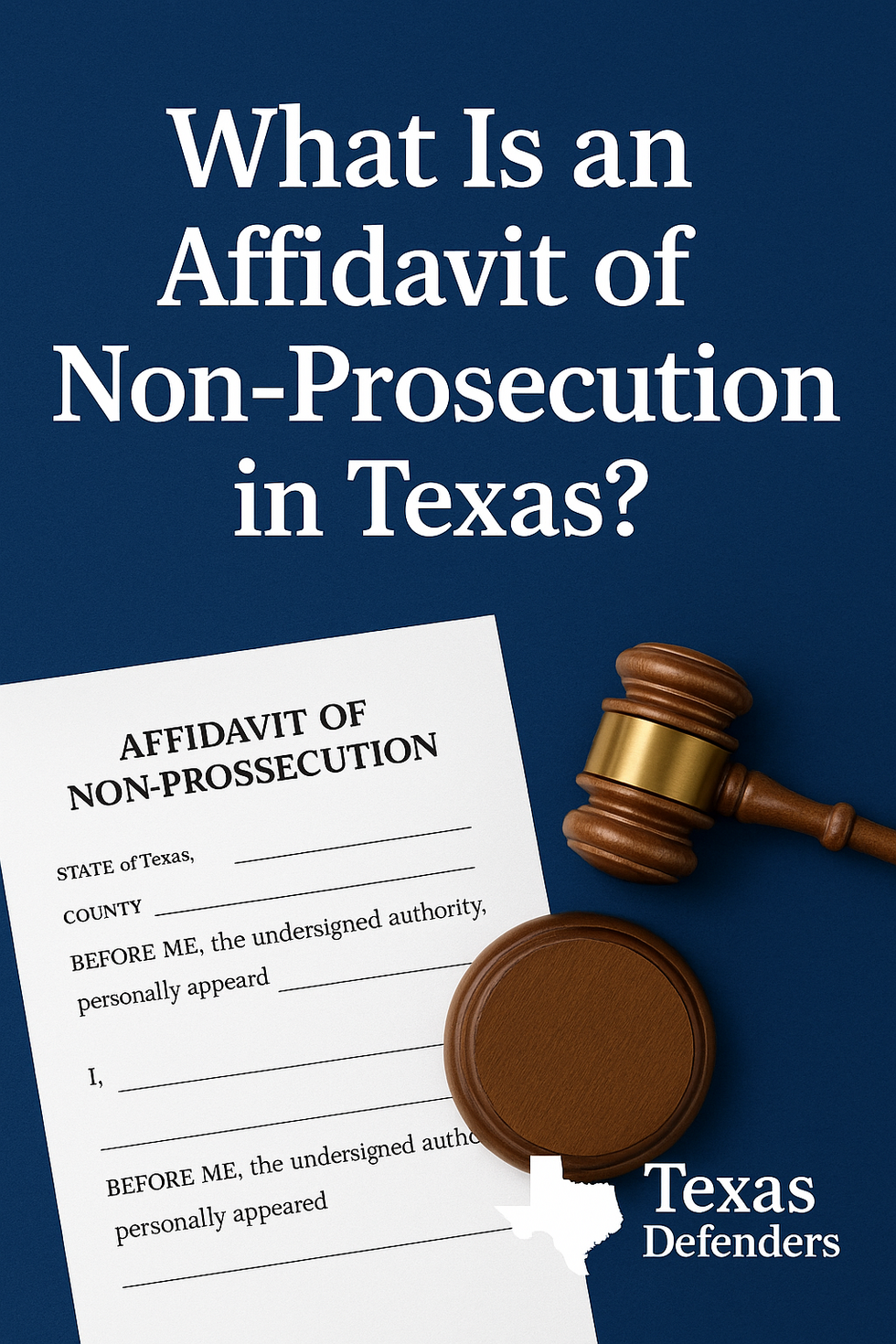
What Is an Affidavit of Non-Prosecution in Texas?
If you've been involved in a criminal case in Texas—especially in cases involving family violence, assault, or harassment—you may have heard of something called an Affidavit of Non-Prosecution. Often referred to as an “affidavit to drop charges,” this legal document is commonly misunderstood. At Texas Defenders, we frequently help clients and their families navigate this complicated process across Dallas, Tarrant, and Collin Counties.
This blog breaks down what an Affidavit of Non-Prosecution really is, how it works, and whether it actually means charges will be dropped.
What Is an Affidavit of Non-Prosecution?
An Affidavit of Non-Prosecution (ANP) is a sworn written statement made by an alleged victim of a crime stating that they do not want the case to move forward. In simple terms, it's the victim's way of saying:
“I don't want to press charges.”
This document is typically used in the following types of cases:
-
Family violence or domestic assault
-
Simple assault
-
Harassment or stalking
-
Terroristic threats
-
Property crimes between family members
However, just because a victim signs one doesn't mean the case is automatically dismissed. That's a major misconception we see in courts throughout Dallas, Fort Worth, and McKinney.
Is It Enough to Drop Charges?
No. Prosecutors—not victims—have the sole authority to dismiss a criminal charge. Once a police report is filed and a case is submitted to the District Attorney's Office, it becomes The State of Texas vs. the Defendant.
This means that even if the victim says they want to “drop the charges,” the State can (and often does) continue to prosecute. Why? Because the State may believe:
-
A crime was still committed
-
The victim is being pressured or intimidated
-
There is sufficient evidence without the victim's cooperation
So, an Affidavit of Non-Prosecution is not a get-out-of-jail-free card.
Why Do People File One?
There are many reasons why a victim may decide to sign an ANP, including:
-
Reconciliation: In family or relationship-based cases, the parties may reconcile and want to move forward together.
-
Regret or misunderstanding: Sometimes what began as an argument escalates unnecessarily and results in a criminal charge.
-
Avoiding court involvement: Victims may want to avoid testifying or reliving a traumatic experience.
-
Pressure from family or community: In some cases, unfortunately, victims may be pressured to sign the affidavit by the accused or others.
Regardless of the reason, it's important that the affidavit be voluntary and truthful—otherwise it can raise serious ethical and legal concerns.
What's in the Affidavit?
Every jurisdiction handles ANPs a bit differently, but they generally include:
-
The victim's name and relationship to the accused
-
A statement that the victim does not wish to pursue charges
-
An explanation of the events and why they want to drop the case
-
An acknowledgment that they were not coerced into signing
-
A warning about potential perjury if the affidavit is untruthful
In some counties, the affidavit must be notarized or completed in front of a prosecutor or court official.
Do Judges or Prosecutors Have to Honor It?
Absolutely not. Prosecutors are trained to evaluate criminal charges independently of the victim's wishes. If there is physical evidence (photos, 911 calls, witness statements), the case may go forward even without the affidavit.
In fact, in domestic violence cases, many Texas counties—like Dallas County and Tarrant County—have “no-drop” policies, meaning they aggressively prosecute cases even when the victim doesn't cooperate.
How Does an Attorney Use an Affidavit of Non-Prosecution?
At Texas Defenders, we often use ANPs strategically as part of a broader defense strategy. Here's how:
-
Negotiating dismissals: While it's not a guarantee, presenting a properly executed ANP early can help convince prosecutors to dismiss or reduce charges—especially in weak or first-time cases.
-
Pretrial Diversion or Deferred Prosecution: Some counties offer programs that allow dismissal after counseling or classes. An affidavit of non-prosecution can support eligibility.
-
Evidence for a Motion to Dismiss: In cases where the alleged victim is the only key witness, a sworn ANP may be used to argue lack of cooperation or insufficient evidence.
That said, we never advise anyone—victim or defendant—to attempt this process without an attorney. Mishandling the process can backfire.
Risks of Misusing an ANP
Filing a false affidavit or coercing someone to sign one is a serious crime. Here are some legal risks to watch for:
-
Perjury: Lying on a sworn document can result in criminal charges.
-
Tampering with a witness: Encouraging a victim to sign an affidavit under pressure or threats can lead to felony charges for the accused.
-
Obstruction of justice: Any attempt to manipulate the judicial process can result in further legal consequences.
Bottom Line: Should You Pursue One?
Every case is different, and not every situation benefits from filing an affidavit of non-prosecution. Before taking any action, both the accused and the alleged victim should speak with an experienced defense attorney.
At Texas Defenders, we've helped hundreds of clients across Dallas, Tarrant, Denton and Collin Counties navigate this exact issue. We know how to approach prosecutors, prepare affidavits correctly, and protect your rights every step of the way.
Need Help With a Pending Case?
If you or a loved one is facing criminal charges and believe an affidavit of non-prosecution may help, don't go it alone. Reach out to Texas Defenders for experienced, aggressive legal representation tailored to your case.
📞 Call us today at 214-306-9696 to schedule a confidential consultation.







Comments
There are no comments for this post. Be the first and Add your Comment below.
Leave a Comment