
Texas THC Laws Explained (2026): Is THCA, Delta-8, and THC Legal in Texas?
Last Updated: July 2026
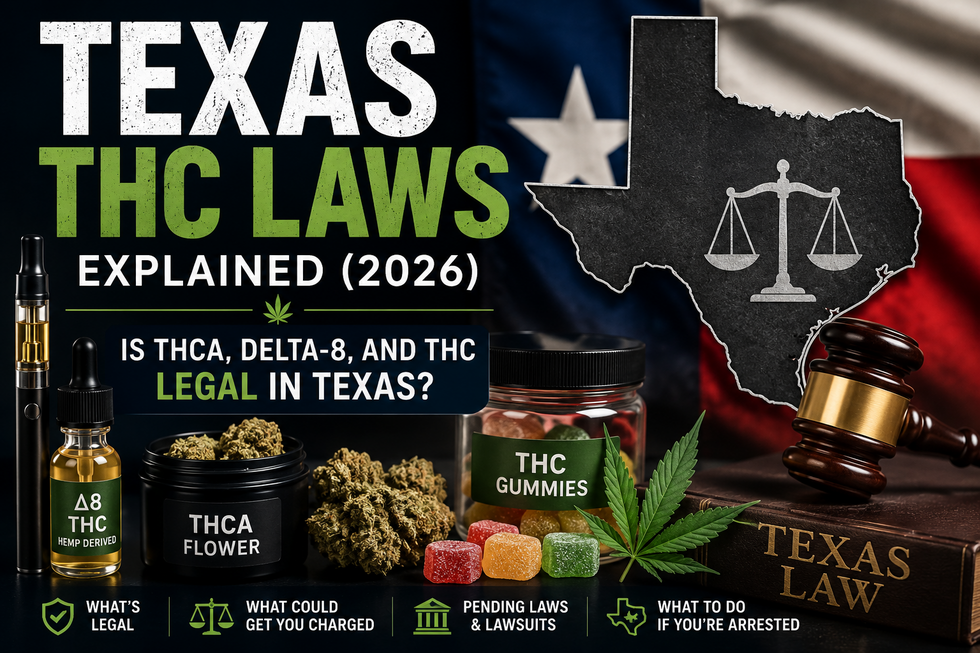
Walk into almost any smoke shop in Texas today and you'll see shelves lined with THC gummies, vape cartridges, THCA flower, Delta-8 products, CBD oils, and dozens of other cannabis-derived products. Many stores advertise them as "legal hemp," while others promise they contain federally compliant THC. To the average consumer, it looks perfectly legitimate.
So why are people still being arrested?
The answer is that Texas THC laws have become one of the most confusing areas of criminal law in the state. Even lawyers, prosecutors, retailers, and law enforcement agencies have disagreed about what is legal, what isn't, and how certain products should be treated under Texas law. Add ongoing lawsuits, changing regulations, proposed legislation, and evolving scientific testing, and it's easy to see why so many Texans are left wondering what they can legally possess.
At Texas Defenders, we've represented clients charged with marijuana possession, THC vape offenses, controlled substance crimes, and other drug-related charges throughout Dallas, Fort Worth, Collin County, Denton County, Bexar County, and across Texas. We also closely follow the latest legislative and court developments because they directly affect how these cases are investigated and prosecuted.
This guide explains what THC is, why the law is so confusing, which products create the greatest legal risks, and what you should know if you are arrested.
Why Are Texas THC Laws So Confusing?
For decades, marijuana law was relatively simple.
If cannabis contained THC, it was generally illegal.
That changed after Congress passed the 2018 Farm Bill, which removed hemp from the federal definition of marijuana so long as it contained no more than 0.3% Delta-9 THC by dry weight. Texas followed with House Bill 1325 in 2019, creating a legal framework for hemp production and hemp-derived products.
Almost overnight, a new industry exploded.
Today you can buy products containing:
-
THCA
-
Delta-8 THC
-
Delta-9 THC (in limited hemp-derived forms)
-
Delta-10 THC
-
HHC
-
CBD
-
CBG
-
THC gummies
-
THC vape cartridges
Many consumers understandably assume that if these products are openly sold in stores, they must be completely legal.
Unfortunately, criminal law doesn't always work that way.
Hemp Is Not the Same Thing as Marijuana
One of the biggest misconceptions is that hemp and marijuana are different plants.
They aren't.
Both come from the cannabis plant.
The legal distinction primarily depends on THC concentration and how the product is classified under state and federal law.
Generally speaking:
Hemp
-
Contains no more than 0.3% Delta-9 THC by dry weight under the applicable legal definition.
Marijuana
-
Generally refers to cannabis exceeding that threshold or otherwise falling outside the legal definition of hemp.
While that sounds straightforward, applying those definitions to modern cannabis products can be anything but simple.
What Is THCA?
THCA may be the most misunderstood cannabinoid in Texas.
Fresh cannabis naturally contains tetrahydrocannabinolic acid (THCA) rather than large amounts of Delta-9 THC.
When THCA is heated—by smoking, vaping, or cooking—it converts into Delta-9 THC through a chemical process known as decarboxylation.
That means products marketed as "THCA flower" can produce effects similar to traditional marijuana when used.
This has become one of the central issues in the legal debate over hemp-derived cannabis products because testing methods and legal definitions do not always align neatly with how consumers actually use these products. Recent legislative proposals have specifically addressed post-decarboxylation testing methods when evaluating THC concentrations.
If you possess THCA products, do not assume that because they were purchased from a retail store they cannot become the subject of a criminal investigation.
Is Delta-8 Legal in Texas?
Delta-8 THC has been the subject of years of litigation.
Unlike naturally abundant Delta-9 THC, Delta-8 is commonly produced from hemp-derived CBD through chemical conversion.
The Texas Department of State Health Services attempted to regulate Delta-8 products, leading to extensive litigation involving companies such as Hometown Hero (Sky Marketing Corp.). Those cases have focused largely on whether state agencies exceeded their authority through administrative rulemaking rather than directly on the wisdom of hemp regulation itself.
Because these issues continue to evolve through the courts and legislative process, consumers should be cautious about relying on simple "legal" or "illegal" labels they find online.
Why THC Vape Pens Can Lead to More Serious Charges
Many people are surprised to learn that possessing a THC vape cartridge may expose them to more serious criminal charges than possessing marijuana flower.
That's because concentrates are often treated differently under Texas law.
A vape cartridge typically contains concentrated cannabinoids rather than raw plant material.
Depending on the facts of the case and the substance involved, prosecutors may pursue controlled substance charges carrying significantly harsher penalties than simple marijuana possession.
This is one reason experienced legal representation matters.
The type of product involved can dramatically affect both the charges filed and the available defenses.
Can You Still Be Arrested If You Bought It Legally?
Yes.
This surprises many people.
Purchasing a product from a smoke shop or CBD retailer does not guarantee that law enforcement will agree the product is legal or that criminal charges cannot be filed.
Officers responding to a traffic stop or other investigation may encounter products that look and smell like marijuana.
In many situations, they cannot determine by sight alone whether a substance is marijuana, hemp, THCA flower, Delta-8, or another cannabinoid.
Laboratory testing often becomes critical.
Even then, disputes may arise regarding testing methods, chain of custody, product composition, and whether prosecutors can prove every element of a criminal offense beyond a reasonable doubt.
Texas Cannabis Laws Continue to Evolve
The legal landscape surrounding hemp-derived cannabinoids has changed dramatically in just a few years.
The Texas Legislature has repeatedly considered new restrictions.
State agencies have adopted and defended regulations.
Businesses have challenged those regulations in court.
The Texas Supreme Court has been asked to resolve important questions involving administrative authority and hemp regulation. At the same time, federal policy regarding cannabis continues to evolve.
As a result, what you read on a website today may no longer accurately reflect the law a year from now.
That is why it is important to rely on current legal information and seek individualized legal advice if you are facing criminal charges.
What Should You Do If You're Arrested?
If you are arrested after police discover a THC product:
-
Remain calm.
-
Do not argue with officers about whether the product is legal.
-
Do not make statements attempting to explain the product's chemistry.
-
Exercise your right to remain silent.
-
Ask to speak with an attorney as soon as possible.
Many THC-related cases involve factual and legal issues that are not obvious during an arrest.
Early intervention by an experienced criminal defense lawyer may significantly affect how your case develops.
Why Choose Texas Defenders?
At Texas Defenders, we represent individuals facing marijuana, THC, and drug-related charges throughout Texas.
Our attorneys stay current on changes in cannabis law, pending litigation, and developing forensic issues because those developments directly affect our clients.
Whether your case involves marijuana, a THC vape cartridge, hemp-derived products, or another cannabinoid, we work to identify every available defense and pursue the best possible outcome.
If you have been arrested in Dallas County, Tarrant County, Collin County, Denton County, Bexar County, or anywhere in Texas, contact Texas Defenders as soon as possible. The law surrounding THC is evolving rapidly, and experienced legal representation can make a meaningful difference.






Comments
There are no comments for this post. Be the first and Add your Comment below.
Leave a Comment