
Tesla Autopilot, Full Self-Driving, and DWI in Dallas: Why Texas Law Still Holds You Criminally Responsible
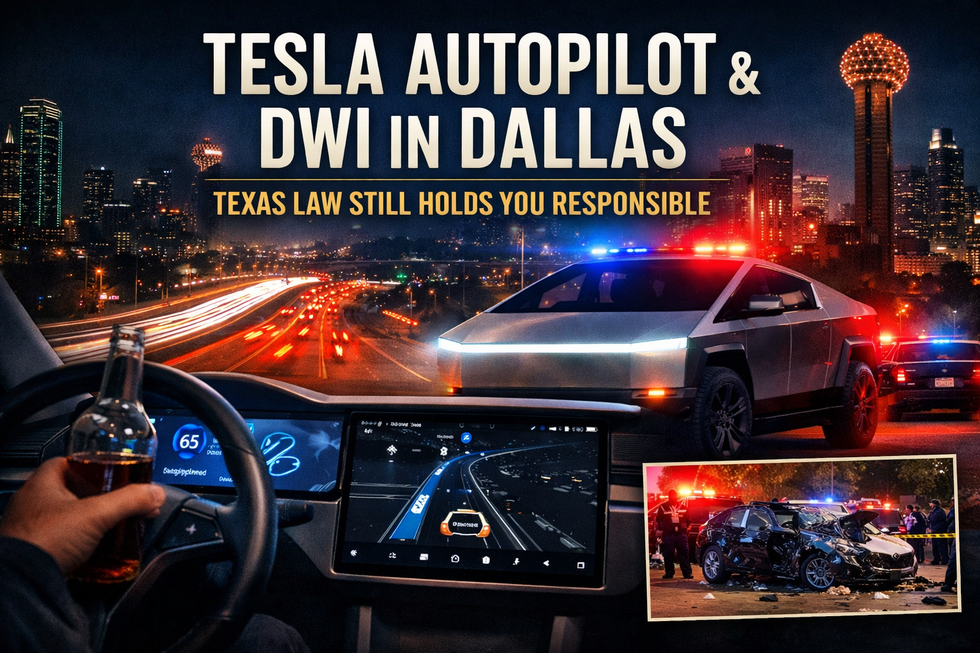
As Tesla vehicles with Autopilot and Full Self-Driving (FSD) features become increasingly common across Dallas County, many drivers assume the technology creates a legal gray area for DWI charges. It does not.
Under Texas law, operating a Tesla—even while using Autopilot or FSD—does not shield an intoxicated driver from DWI prosecution. In fact, recent arrests and fatal crashes in Dallas involving Teslas confirm that law enforcement and prosecutors are treating these cases aggressively.
This article breaks down the statutory authority, real Dallas incidents, and why “the car was driving itself” is not a valid defense in Texas.
Texas DWI Law: The Statutory Foundation
Texas DWI law is found in Texas Penal Code § 49.04, which provides:
“A person commits an offense if the person is intoxicated while operating a motor vehicle in a public place.”
There are only three elements the State must prove:
-
A person
-
Was intoxicated
-
While operating a motor vehicle in a public place
Notably, the statute never requires active steering, acceleration, or manual driving.
“Operating” Is Interpreted Broadly
Texas courts have consistently interpreted “operating” to mean exerting control or having the capability to control a vehicle, not necessarily driving in the traditional sense.
Examples Texas courts have found sufficient for “operation” include:
-
Sitting in the driver's seat with keys available
-
Engaging vehicle systems
-
Directing a vehicle's movement
-
Having the ability to intervene
A Tesla driver using Autopilot or FSD still:
-
Chooses to enter the vehicle
-
Engages the driving system
-
Remains in the driver's seat
-
Retains ultimate control
That is enough for a DWI charge.
SB 2205: Automated Vehicles Are Legal — Intoxicated Drivers Are Not
Texas addressed automated vehicles in Senate Bill 2205, codified primarily in the Texas Transportation Code.
What SB 2205 Actually Does
SB 2205:
-
Allows automated motor vehicles on Texas roads
-
Removes certain licensing requirements for the vehicle itself
-
Clarifies regulatory authority
What SB 2205 Does NOT Do
SB 2205 does not:
-
Legalize intoxicated driving
-
Remove criminal liability from human occupants
-
Override Penal Code § 49.04
Even with automation, Texas law still requires a licensed, sober driver capable of taking control unless the vehicle meets strict definitions of a fully autonomous system operating without human involvement—which Teslas currently do not under Texas law.
Tesla itself reinforces this point in its user manuals, stating that Autopilot and FSD require active driver supervision at all times.
Real Dallas Incidents Involving Teslas and DWI
This legal issue is no longer hypothetical. Dallas-area arrests show exactly how police and prosecutors are applying the law.
Dallas North Tollway Cybertruck DWI Arrest (November 2025)
In November 2025, a driver was arrested for DWI after allegedly driving the wrong way on the Dallas North Tollway in a Tesla Cybertruck.
Despite speculation that driver-assist features may have been engaged, officers treated the incident as a standard DWI. The presence of cutting-edge technology did not prevent arrest or charges.
This case underscores a key reality: Dallas police view the human in the driver's seat as responsible—period.
Fatal Tesla Crash in Uptown Dallas (2025)
In another 2025 case, an alleged intoxicated Tesla driver caused a fatal crash in Uptown Dallas.
When a death occurs, DWI exposure escalates to:
-
Intoxication Manslaughter (Texas Penal Code § 49.08)
-
A second-degree felony, punishable by
-
2–20 years in prison
-
Up to $10,000 in fines
-
Autopilot or FSD use does not mitigate these charges. In fact, prosecutors often argue that relying on automation while intoxicated demonstrates reckless disregard for human life.
Why “The Car Was Driving” Fails as a Defense
Control Still Exists
Texas courts focus on potential control, not constant physical input.
If you can:
-
Override the system
-
Apply brakes
-
Steer
-
Accelerate
You are operating the vehicle.
Automation Can Hurt, Not Help
In many cases, prosecutors argue:
-
Engaging Autopilot while intoxicated is a conscious decision
-
The driver knowingly placed trust in technology while impaired
-
This shows poor judgment consistent with intoxication
Rather than creating reasonable doubt, Autopilot data can strengthen the State's case.
Tesla Vehicle Data and DWI Prosecutions
Modern Teslas record extensive telemetry, including:
-
Speed and acceleration
-
Steering input
-
Braking events
-
Autopilot/FSD engagement
-
Driver warnings and overrides
Law enforcement may seek this data through warrants or subpoenas. Prosecutors increasingly rely on vehicle data to:
-
Rebut defense claims
-
Establish timelines
-
Show driver engagement
This makes early legal intervention critical. Mishandled data issues can permanently damage a defense.
Penalties for a Tesla DWI in Dallas County
A Tesla DWI carries the same penalties as any other DWI, including:
-
Jail time
-
Fines up to $2,000+
-
Driver's license suspension
-
Ignition interlock device
-
Probation
-
Permanent criminal record
Aggravating factors—such as wrong-way driving, crashes, or injuries—dramatically increase exposure.
Bottom Line: Self-Driving Tech Does Not Replace Criminal Responsibility
Texas law is clear:
-
Automation does not equal immunity
-
Intoxication + control = DWI
-
Technology evolves faster than criminal statutes—but the statutes still apply
If you were arrested for DWI in Dallas involving a Tesla, Autopilot, or Full Self-Driving, you need a defense team that understands both the law and the technology.
Charged With a Tesla DWI in Dallas? Act Fast.
At Texas Defenders, we handle complex DWI cases involving:
-
Vehicle data
-
Emerging technology
-
Dallas County prosecutors
📍 3302 Swiss Circle, Dallas, TX 75204
📞 Call or text now: 214-306-9696
The sooner you act, the more options you may have. Autopilot won't protect you—but the right defense strategy might.







Comments
There are no comments for this post. Be the first and Add your Comment below.
Leave a Comment