
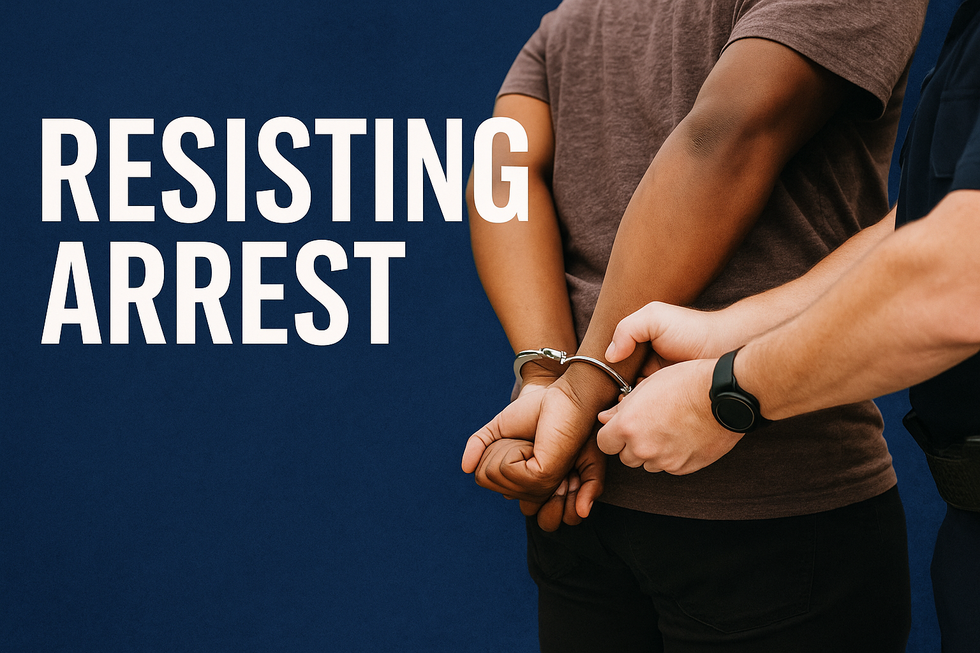
Resisting Arrest in Texas: What Counts as Resistance Might Surprise You
Understanding the Charge of Resisting Arrest
In Texas, resisting arrest is a serious criminal offense—even if the resistance is non-violent or momentary. Under Texas Penal Code § 38.03, a person commits the offense of resisting arrest if they intentionally prevent or obstruct a peace officer from lawfully arresting, searching, or transporting them. The key word is intentionally, but Texas law does not require that the resistance be aggressive, prolonged, or dangerous.
You can be charged with resisting arrest just by pulling your arm away, tensing your muscles, or otherwise making the officer's job more difficult.
How Little Resistance Is Enough?
Contrary to what many people assume, resisting arrest isn't limited to situations where someone punches a cop or runs away. Courts have upheld charges of resisting arrest in cases where the accused:
-
Pulled their arm away while being handcuffed
-
Tensed up during a pat-down
-
Refused to give their hands for cuffing
-
Rolled over or shifted away while being detained
-
Verbally refused to comply with commands in a physical context
-
Struggled even slightly while being placed in a patrol car
In each of these examples, the “resistance” might seem minor to a bystander, but the law allows officers to interpret even small actions as obstruction. And once that discretion is exercised, you may find yourself with an additional charge—even if the original arrest is later dismissed.
Officer Discretion Plays a Major Role
One of the most frustrating aspects of resisting arrest cases is that the law gives wide latitude to law enforcement officers. Whether resistance occurred is largely determined by what the officer reports.
There is no requirement that a specific level of force or danger be present. In practice, that means if an officer feels that you weren't being cooperative—even if you never touched them or acted aggressively—you can still be arrested and charged.
This leads to many scenarios where:
-
A person is startled or confused, and pulls back reflexively.
-
An individual tries to ask a question or clarify and is perceived as stalling.
-
Someone in a heightened emotional state responds non-compliantly, but not violently.
In all of these cases, an officer may view the behavior as obstruction, and prosecutors often side with law enforcement unless there is clear video evidence to the contrary.
What About Unlawful Arrests?
A common misconception is that if the arrest is unlawful, you have the right to resist. That is not true in Texas.
Texas law clearly states that you may not resist arrest, even if the arrest is later found to be unlawful. The correct response is to comply peacefully and fight the arrest later in court with the help of an experienced criminal defense attorney.
This is one of the most misunderstood parts of resisting arrest law. Trying to assert your rights physically—even just by backing away—can result in charges that are harder to beat than the original offense.
Penalties for Resisting Arrest in Texas
Resisting arrest is typically charged as a Class A misdemeanor, punishable by:
-
Up to 1 year in jail
-
Up to $4,000 in fines
If you use a deadly weapon while resisting, the charge escalates to a third-degree felony, carrying:
-
2 to 10 years in prison
-
Up to $10,000 in fines
These penalties are in addition to whatever charge you were initially facing. In some cases, the resisting arrest charge can actually become the more serious offense.
The Importance of Video Evidence
In today's environment, body-worn cameras and bystander video often play a crucial role in resisting arrest cases. Without video, the case becomes your word against the officer's—and most prosecutors and judges will side with law enforcement.
However, video can show that:
-
You were not being aggressive
-
The officer escalated unnecessarily
-
The resistance was minimal or due to confusion
If you are charged with resisting arrest, your attorney will seek all available video evidence to challenge the officer's account and protect your rights.
What to Do If You're Accused of Resisting Arrest
If you or a loved one has been charged with resisting arrest in Dallas, Fort Worth, Plano, McKinney, Denton, or any surrounding county, here's what you should do:
-
Remain silent and don't try to explain yourself to police or prosecutors.
-
Call an experienced criminal defense attorney immediately.
-
Request bodycam footage and any surveillance video.
-
Document any injuries or evidence that supports your side of the story.
At Texas Defenders, we know how quickly a minor incident can turn into a major legal problem. We defend people across Dallas, Tarrant, Collin, and Denton Counties who are charged with resisting arrest—often for doing less than most people would expect.
Final Thoughts
You don't have to fight, punch, or run to be charged with resisting arrest in Texas. Something as simple as tensing up, hesitating, or pulling away can be enough. Officer discretion plays a huge role, and resisting charges are often used to justify or escalate questionable arrests.
If you're facing this kind of charge, you need someone in your corner who knows how to challenge vague allegations and protect your future. Call Texas Defenders today at 214-306-9696 to schedule a confidential consultation and start building your defense.







Comments
There are no comments for this post. Be the first and Add your Comment below.
Leave a Comment