
Former Dallas Police Union Leader Pleads Guilty to False Statement After Fatal Crash Investigation
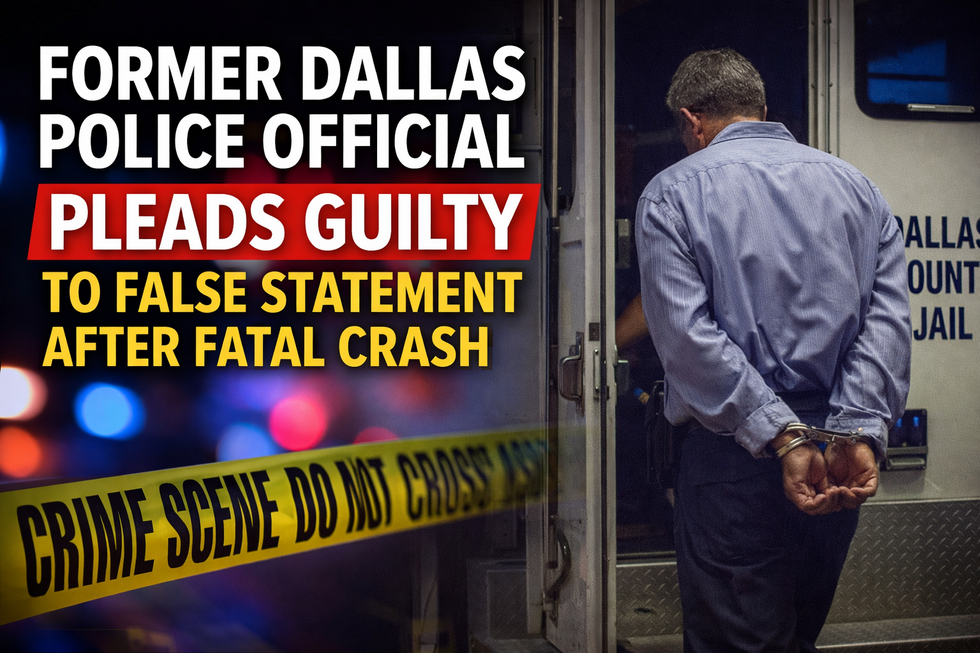
A former high-ranking Dallas police official recently pleaded guilty in a Dallas County criminal court to making a false statement to investigators following a fatal traffic crash. The case has drawn public attention because of the seriousness of the underlying incident and the position the defendant previously held within the Dallas Police Department.
While the criminal case itself was resolved with a plea agreement, the circumstances surrounding the crash and the investigation continue to generate scrutiny. A civil lawsuit filed by the victim's family in January 2026 means additional details may emerge as the litigation progresses.
This case also highlights an important but often misunderstood criminal charge in Texas: making a false statement to law enforcement.
The Fatal Crash and the Investigation
The incident at the center of the case occurred in March 2025 and involved a fatal traffic crash in Dallas.
According to court filings, the defendant was a passenger in a vehicle involved in the crash. During the subsequent investigation, law enforcement officers interviewed the occupants of the vehicle in order to determine who had been driving and what circumstances led to the collision.
Prosecutors later alleged that the defendant knowingly provided false information during that investigation.
Specifically, investigators alleged that the defendant falsely stated that another person had been driving the vehicle and that neither of them had consumed alcohol prior to the crash. According to the charging documents, those statements were material to the investigation of the fatal traffic collision.
Because investigators rely heavily on statements from witnesses and involved parties when reconstructing crash events, providing false information during a criminal investigation can itself become a criminal offense under Texas law.
The Criminal Charge: False Statement to a Peace Officer
The charge filed in the case was False Statement to a Peace Officer or Law Enforcement Employee, a violation of Texas Penal Code §37.08.
Under Texas law, a person commits this offense if they:
-
Knowingly make a false statement
-
With the intent to deceive
-
To a peace officer conducting a criminal investigation
-
When the statement is material to the investigation
The statute exists because investigators must be able to rely on truthful information when determining what occurred in a criminal incident. False statements can obstruct investigations, misdirect investigators, and delay justice for victims.
In this case, prosecutors alleged the false statement concerned who was driving the vehicle involved in the fatal crash and whether alcohol had been consumed prior to the collision.
Penalty for the Offense
Making a false statement to a law enforcement officer during an investigation is typically charged as a Class B misdemeanor in Texas.
Potential penalties can include:
-
Up to 180 days in county jail
-
A fine of up to $2,000
-
Probation or community supervision
Even though the offense is a misdemeanor, it can still have serious consequences, especially for individuals whose professions require trust, licensing, or government employment.
The Guilty Plea and Sentence
Court records show that the defendant entered a guilty plea in March 2026 in Dallas County Criminal Court. The court accepted the plea and placed the defendant on deferred adjudication community supervision for 12 months along with a $500 fine.
Deferred adjudication means that the court does not enter a final conviction as long as the defendant successfully completes the probationary period and complies with all court-ordered conditions.
If the person successfully completes supervision, the case may be eligible for dismissal at the end of the probation term.
However, violating probation conditions could allow the court to proceed to a conviction and impose additional penalties.
Conditions of Probation
The court imposed a number of supervision conditions in this case, including:
-
Completing 12 months of community supervision
-
Paying fines and court costs
-
Completing 30 hours of community service
-
Participating in a DWI education program
-
Undergoing a drug and alcohol evaluation
-
Surrendering the defendant's peace officer license
-
Avoiding alcohol and illegal drugs during the probation period
These conditions appear in the court's official probation order.
Why the Court Required DWI Education and Substance Evaluation
One notable aspect of the case is the requirement that the defendant complete DWI education classes and a drug and alcohol evaluation as part of the probation terms.
These requirements are commonly imposed in cases involving alcohol-related driving offenses that our Dallas DWI lawyers handle on a daily basis.
Although the defendant in this case was not charged with Driving While Intoxicated, courts often order these programs when alcohol may have played a role in the events surrounding a case.
In practice, courts rarely impose DWI-related programs unless they believe alcohol may have been a factor in the underlying incident. When such conditions appear in a plea agreement, it can suggest that prosecutors and the court believed alcohol could have been involved even if the evidence was not sufficient to prove a DWI charge beyond a reasonable doubt.
This does not mean a DWI occurred or could have been proven in court. However, the presence of those conditions indicates that alcohol-related concerns likely played a role in how the case was resolved.
Surrender of Law Enforcement License
Another significant condition of the plea agreement required the defendant to permanently surrender his peace officer license.
In Texas, peace officers are licensed by the Texas Commission on Law Enforcement (TCOLE). Losing that license effectively ends a person's ability to serve as a police officer in the state.
Court records specifically require the permanent surrender of the peace officer license and certificates issued by TCOLE as part of the case disposition.
For someone with decades of law enforcement experience, this consequence can be one of the most significant outcomes of the case.
Controversy Surrounding the Investigation
The case has generated controversy in Dallas, particularly because of the public role the defendant previously held in the police community.
Family members of the crash victim have publicly questioned aspects of the investigation and raised concerns about whether the initial facts surrounding the crash were accurately presented.
According to public reporting, the victim's family believed there were inconsistencies regarding what happened immediately after the crash and how information was communicated.
While the criminal case related to the false statement has now been resolved through the plea agreement, those broader questions have not been fully litigated in court.
Civil Lawsuit Filed by Victim's Family
In January 2026, the victim's family filed a civil lawsuit related to the fatal crash.
Civil litigation operates independently from the criminal justice system. While criminal cases determine whether someone violated criminal law, civil cases focus on financial liability and damages.
As the civil lawsuit moves forward, it may involve depositions, witness testimony, and additional evidence related to the crash and its aftermath.
Because civil cases often involve extensive discovery, additional information about the incident could become public as the case progresses.
Why False Statements to Police Are Taken Seriously
Cases involving false statements to law enforcement are taken seriously by prosecutors because they can undermine criminal investigations.
Investigators rely on truthful information when determining:
-
who was responsible for an incident
-
what actions led to a crime
-
whether alcohol or drugs were involved
-
whether criminal charges should be filed
When someone intentionally provides false information during an investigation, it can divert investigative resources and delay justice for victims and their families.
Texas law therefore makes it a criminal offense to knowingly provide false statements that are material to a criminal investigation.
Legal Lessons From the Case
This case illustrates several important legal realities:
-
Statements to police matter
Anything said during a criminal investigation can potentially become evidence. -
False statements can lead to criminal charges
Even if a person was not responsible for the original incident, lying to investigators can still create criminal liability. -
Investigations can continue for years
The crash occurred in 2025, but the criminal case was not resolved until 2026. -
Civil cases can reveal additional facts
Because a civil lawsuit has been filed, more information may emerge as the case proceeds through the courts.
Final Thoughts
The Dallas case involving a false statement after a fatal crash investigation highlights how quickly legal exposure can expand beyond the initial incident.
Even when someone is not charged with causing a crash, statements made during the investigation can still lead to criminal liability if prosecutors believe the information provided was intentionally false.
With a civil lawsuit now pending, the full story surrounding the crash and the investigation may continue to unfold in the months ahead.
FAQ: False Statements to Police and Crash Investigations in Texas
1. What is the charge for making a false statement to police in Texas?
In Texas, knowingly making a false statement to a peace officer during a criminal investigation is a crime under Texas Penal Code §37.08. The law applies when a person intentionally gives false information that is material to an investigation.
2. Is making a false statement to police a felony or misdemeanor?
Most cases are charged as a Class B misdemeanor in Texas. A conviction can result in up to 180 days in county jail and a fine of up to $2,000, although many cases are resolved through probation or deferred adjudication.
3. What does “material to the investigation” mean?
A statement is considered material if it could influence how investigators understand or evaluate the facts of a case. For example, falsely identifying the driver of a vehicle involved in a crash could affect how police determine responsibility.
4. Can you be charged for lying to police even if you weren't the driver?
Yes. The offense focuses on lying during an investigation, not necessarily committing the underlying crime. Someone who was only a passenger or witness could still face charges if they knowingly give false information to investigators.
5. What happens if someone pleads guilty to a false statement charge in Texas?
Depending on the case, a court may impose jail time, fines, probation, or deferred adjudication. Deferred adjudication allows a person to avoid a final conviction if they successfully complete the probation period.
6. What is deferred adjudication in Texas?
Deferred adjudication is a form of probation where the court defers a finding of guilt while the defendant completes supervision conditions. If the terms are completed successfully, the case can ultimately be dismissed.
7. Why would a court require DWI classes if someone was not charged with DWI?
Courts sometimes order DWI education programs or substance abuse evaluations when alcohol may have played a role in the events surrounding the case. These conditions are common in probation agreements where alcohol-related concerns exist.
8. What is a substance abuse evaluation in a criminal case?
A substance abuse evaluation is an assessment performed by a licensed professional to determine whether a person has alcohol or drug dependency issues. The court may order treatment if the evaluation recommends it.
9. Can police officers be charged with crimes like anyone else?
Yes. Police officers are subject to the same criminal laws as any other person. If investigators believe an officer committed a crime, the case can be prosecuted in the same courts that handle other criminal cases.
10. Can a criminal case and a civil lawsuit happen at the same time?
Yes. A criminal case addresses whether someone violated criminal law, while a civil lawsuit focuses on financial liability and damages. Both can proceed independently of each other.
11. What happens in a civil lawsuit after a fatal crash?
Civil lawsuits may involve depositions, evidence exchange, expert testimony, and trial proceedings. These cases often uncover additional details about the events surrounding a crash.
12. How long can a crash investigation take in Texas?
Investigations can take months or even years, especially in serious incidents such as fatal crashes. Prosecutors may wait until investigators gather sufficient evidence before filing charges.
13. What should someone do if police ask questions after a crash?
Anyone involved in a crash investigation has the right to remain silent and the right to speak with an attorney before answering questions. Speaking with a lawyer can help ensure statements are accurate and legally protected.
14. Can giving inaccurate information to police lead to criminal charges?
Yes. If investigators believe the false information was intentional and meant to mislead, it can result in criminal charges for making a false statement or other offenses.
15. Why are truthful statements important in criminal investigations?
Investigators rely on accurate information to reconstruct events, determine responsibility, and ensure justice for victims. False statements can delay investigations and potentially interfere with criminal proceedings.







Comments
There are no comments for this post. Be the first and Add your Comment below.
Leave a Comment