
You're Not Alone. We're on it!
At Texas Defenders, we do not view our clients as case numbers. We view them as people with families, careers, reputations, goals, and futures that matter.
We understand that if you or a loved one is charged with a criminal offense it can feel overwhelming, stressful, and uncertain. For many people, this is one of the most difficult moments of their lives.
We want you to know something important right away: when you hire Texas Defenders, you are not hiring just one attorney. You are hiring an entire team — attorneys, paralegals, legal assistants, and support staff — all working together on your behalf.
Our job is to stand between you and the criminal court process, protect your rights, and relentlessly work toward the best possible outcome in your case.
1. How Texas Defenders Works
Criminal cases are a process — not a single event. Good outcomes are built over time through preparation, investigation, strategy, negotiation, and patience. Understanding that from the beginning will help you work with our team more effectively and reduce unnecessary stress along the way.
Once you hire us, here is what happens immediately:
- We confirm your contact information and the key details of your case.
- We review the charge, county, court, bond status, and any upcoming court dates.
- We open your file in our case management system and assign the right team members.
- We begin requesting or monitoring for discovery — police reports, videos, lab results, and prosecutor updates.
2. The Phases of Your Case
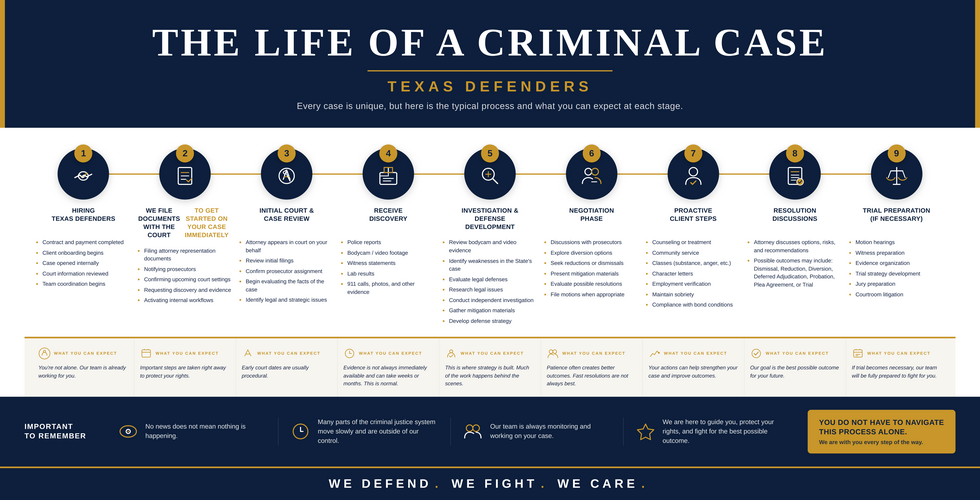
Most criminal cases move through a series of phases. The timeline and details vary depending on the county, the charge, the prosecutor, the judge, and the facts of your case — but the general process is consistent. Here is what each phase typically looks like and what you should know.
Phase 1 — Hiring Texas Defenders
The moment you hire us, our team begins working. We start onboarding your case, reviewing your court information, activating our internal workflows, and beginning our initial strategy review. You are not facing this process alone anymore.
Phase 2 — We Begin Working on Your Case Immediately
Our office takes formal steps right away to protect your interests, even if you do not see all of them. Depending on your case, this may include filing our attorney representation documents with the court, notifying prosecutors that you are represented, confirming upcoming court dates, and requesting evidence and discovery materials.
Phase 3 — Initial Court & Case Review
The early stages of a criminal case are often procedural. Your attorney may appear in court on your behalf, review the initial filings, confirm who the prosecutor is, and begin identifying legal and strategic issues. The first court setting rarely resolves the case. Early court dates are usually about gathering information and moving the process forward — not reaching a final outcome.
Phase 4 — Receiving Discovery
Discovery is the evidence related to your case. It may include police reports, bodycam footage, dashcam footage, surveillance video, witness statements, lab results, 911 calls, and photographs.
Evidence is often not immediately available. Depending on the county and the agency involved, discovery can sometimes take weeks or months to be released. This is extremely common and does not mean something is wrong. Our team actively monitors and requests evidence throughout the process — we are not waiting passively.
Phase 5 — Investigation & Defense Development
Once evidence becomes available, our team begins deeper review and case analysis. This is where significant work happens, even if it is not always visible to you. We review bodycam and video evidence, identify weaknesses in the State's case, evaluate possible legal defenses, research legal issues, conduct independent investigation when needed, gather mitigation materials, and develop your defense strategy.
Phase 6 — Negotiation
As the case develops, negotiations and strategic discussions begin. This may involve discussions with prosecutors, exploring diversion options, seeking reductions or dismissals, presenting mitigation materials, evaluating possible resolutions, and filing motions when appropriate.
Fast resolutions are not always the best resolutions. In many situations, patience and preparation create better opportunities for favorable outcomes than rushing toward an early deal.
Phase 7 — Proactive Steps You Can Take
Depending on the facts of your case, taking proactive steps on your own can sometimes improve negotiations and case outcomes. If our office recommends any of the following, completing them promptly can make a real difference:
- Online classes
- Counseling or treatment programs
- Substance abuse evaluation
- Character letters from employers, family, or community members
- Employment verification
- Staying in full compliance with all bond conditions
Phase 8 — Resolution Discussions
As your case progresses, your attorney will walk you through the best available options based on your specific case(s), explain the risks and benefits of each, and give you a clear recommendation. Possible outcomes may include dismissal, reduction of charges, a diversion program, deferred adjudication, probation, a negotiated plea agreement, or proceeding to trial. Our goal at every stage is to protect your future and pursue the best available outcome.
Phase 9 — Trial Preparation (If Necessary)
Many cases resolve without going to trial. But when the State will not offer a fair resolution, our team is fully prepared to take your case to a judge or jury. Trial preparation may include motion hearings, witness preparation, evidence organization, trial strategy development, jury preparation, and courtroom litigation. If it comes to trial, we will be ready.
3. What We Are Doing Behind the Scenes
A lot of criminal defense work happens outside of what you can directly see. Court may only occur every few weeks or months, but our work continues in between. Even during quiet periods, your case is being actively monitored and worked on.
Depending on the stage of your case, our team may be:
- Monitoring court settings and filing updates
- Requesting and reviewing discovery materials
- Communicating with prosecutors and court staff
- Reviewing bodycam footage, videos, and other evidence
- Evaluating legal issues and possible defenses
- Looking for illegal stops, searches, arrests, or statements
- Analyzing whether the State can actually prove every element of the charge
- Gathering and preparing mitigation materials
- Researching relevant legal issues
- Preparing motions when appropriate
- Exploring diversion, reduction, dismissal, deferred adjudication, or trial options
- Reviewing bond conditions and whether a modification may be appropriate
- Coordinating internally between attorneys, paralegals, and support staff
Not every strategy is visible right away
Sometimes the best strategy is to push hard early. Sometimes it is smarter to wait for discovery. Sometimes it is better not to telegraph every defense angle to the prosecutor too soon. The right approach depends on timing, evidence, the county, the prosecutor, and the judge.
4. What Is Normal in a Criminal Case
The criminal court process can feel unfamiliar, slow, and stressful — especially if this is your first experience with the legal system. Many clients worry that delays or quiet periods mean something is wrong. In reality, most of what feels abnormal is completely routine.
The following are all very common in criminal cases:
- Cases taking several months or longer from start to resolution
- Court dates being reset or continued
- Long periods without major visible updates
- Delays in receiving police reports, videos, or lab results
- Prosecutors taking significant time to review cases or respond
- Multiple court appearances before any meaningful resolution
- Cases not resolving at the first — or even third — court setting
- Waiting on grand jury review in felony cases
Time can actually work in your favor
Additional time is not automatically a bad thing. In many situations, more time allows for better investigation, stronger negotiations, completion of proactive steps or mitigation, more thorough evidence review, and additional opportunities for favorable resolutions. Patience is often a deliberate part of the strategy — not a sign of inaction.
5. What We Need From You
One of the most important things you can do during your case is remain available and responsive. Please make sure our office always has your current phone number, email address, and contact information and try to respond promptly if our team reaches out regarding your case. Good communication helps us move your case forward as efficiently and effectively as possible.
Documents
Send us bond paperwork, citations, court notices, police paperwork, jail release documents, protective orders, probation documents, or any paperwork you received related to this case.
Witnesses
Provide names, phone numbers, and emails for anyone who may have relevant knowledge. Include a brief note explaining what each person knows. Do not pressure witnesses or tell them what to say.
Personal Concerns
Tell us early if you have concerns about immigration status, professional licenses, security clearances, employment, school enrollment, military status, upcoming travel, or related family court matters.
Tell us the truth — even if it is uncomfortable
Your conversations with our legal team are protected by attorney-client privilege. We need accurate and complete information to give you the best possible defense. Surprises in court are rarely helpful. If there is something you think we might not want to hear — tell us anyway, and tell us early.
6. How Communication Works
One of the hardest parts of a criminal case is the waiting. We understand that not hearing anything can feel like nothing is happening. In most cases, the silence means the system itself is waiting — on a court setting, a prosecutor decision, a lab result, a grand jury, or a discovery release. That is a reflection of how slowly the criminal justice system moves, not a reflection of how hard our team is working.
Who may contact you
Depending on the issue, you may hear from an attorney, a paralegal, a legal assistant, or a member of our administrative or billing team. Not every question or update requires a call with an attorney. Many scheduling, document, and status issues can be handled quickly by our staff.
Our office will contact you when:
- A court appearance is required
- Important evidence or discovery is received
- There are meaningful developments in your case
- The prosecutor makes an offer or recommendation
- We need documents, information, or action from you
- We recommend proactive steps such as classes or counseling
- Strategic decisions need to be discussed with you
Contact us immediately if:
- You are arrested, detained, or contacted by law enforcement
- You receive a new court notice or believe a warrant may have been issued
- You are contacted by a detective, prosecutor, alleged victim, witness, probation officer, or bond officer
- You may have violated a bond condition
- You have a travel emergency or cannot make a scheduled court date
- Your phone number, email address, or home address changes
- You receive paperwork related to the case from an immigration agency, licensing board, employer, or school
- You pick up a new charge or are cited for any offense
7. What Not To Do While Your Case Is Pending
What you do — and do not do — while your case is pending can have a real impact on the outcome. Even a strong case can become much harder if you miss a court date, violate a bond condition, contact a protected person, or pick up a new charge. Please take this section seriously.
- Do not miss court. If you are unsure whether your appearance is required, contact us before the date — never assume.
- Do not ignore communications from our office. When we reach out, respond promptly.
- Do not speak to law enforcement without talking to us first. This includes police, detectives, investigators, and prosecutors.
- Do not contact the alleged victim or any protected person if a no-contact order or bond condition prohibits it. Do not ask someone else to do it on your behalf either.
- Do not post about your case on social media. Avoid sharing details about the incident, comments about witnesses, or anything that could be misunderstood or used against you.
- Do not delete evidence — texts, photos, videos, or anything else — without speaking to us first.
- Do not travel outside of Texas or the country if your bond conditions restrict travel, unless you have written approval.
- Do not use alcohol, drugs, or firearms if your bond conditions prohibit it — even once.
- Do not assume a violation will be excused because you had a good reason. Bond conditions are court orders. Violations can result in arrest.
8. How to Help Your Case
There are real things you can do right now that may strengthen your position and improve the possibilities for a favorable outcome. Prosecutors and judges notice when a defendant takes their situation seriously — and that can matter in negotiations.
In addition to anything our office specifically recommends, consider the following:
- Stay out of any further legal trouble — new charges are serious and can affect everything
- Maintain steady employment or school enrollment
- Complete counseling, treatment, or classes if recommended by our office
- Pursue substance abuse treatment if relevant to your case
- Follow all bond and probation conditions precisely
- Keep your contact information current with our office at all times
- Respond promptly when we reach out to you
9. Court Appearances
Whether you need to be physically present in court depends on the court, the county, the judge, the type of setting, your bond status, and the charge. Some court appearances can be handled entirely by your attorney. Others require you to be there in person. Do not assume you can skip a court date unless our office has specifically told you your appearance is excused.
Before a court date
- Confirm the date, time, court, and exact location with our office.
- Arrive early — account for traffic, parking, and courthouse security lines.
- Dress respectfully. Business casual or better is always appropriate.
- Bring a valid photo ID.
- Do not bring weapons, contraband, or anything prohibited inside a courthouse.
What to expect at court
Many court settings are procedural rather than dramatic. The case may be reset for a future date, discovery may be discussed, or negotiations may occur in the background. Sometimes the court simply needs to confirm the current status of the case. We will tell you what to expect before each specific setting.
10. Possible Outcomes
No attorney can ethically promise a specific result. Outcomes depend on the facts, the evidence, the law, the prosecutor, the judge, the county, your criminal history, the available legal options, and your personal goals. Our job is to protect you, identify every weakness in the State's case, and pursue the best outcome available.
Every case is different, and effective criminal defense often requires careful analysis, preparation, negotiation, and strategy.
Before making recommendations, our team works to thoroughly review
- The evidence
- Legal issues and possible defenses
- The strengths and weaknesses of the case
- Mitigation and proactive efforts
- The potential long-term consequences of different outcomes
- Your personal goals and priorities
Once we have thoroughly evaluated every aspect of the case, we will discuss the available options, strategy considerations, and recommendations with you so you can make informed decisions moving forward on your case(s).
Our approach is centered on protecting not only your case, but also your future.
11. Clearing Your Record After the Case
Many clients want to know whether the case can be removed from their record when it is over. The answer depends on the final outcome, the specific charge, any applicable waiting periods, your criminal history, and Texas law. A dismissal does not automatically erase the record. Clearing a record is a separate legal process.
Key terms to understand
- Expunction: A court order that can destroy or remove eligible arrest and case records from public agencies. This is the most complete form of record clearing available under Texas law.
- Nondisclosure: A court order that seals eligible records from most public searches but does not destroy them. Law enforcement and certain agencies may still be able to access a sealed record.
- Waiting period: Many cases require a waiting period before you can file for expunction or nondisclosure. The length depends on the charge and outcome.
- Eligibility: Not every outcome qualifies for expunction or nondisclosure. Eligibility depends on the specific charge, how the case resolved, and your overall criminal history.
12. Your Team at Texas Defenders
When you hire Texas Defenders, you are supported by an entire team — not just a single attorney. This team-based approach allows us to provide consistent organization, responsive communication, and thorough support throughout the life of your case.
Your team may include:
- Attorneys — who lead the legal strategy, appear in court, and advise you on major decisions
- Paralegals — who help manage your case file, coordinate evidence and discovery, and support attorney preparation
- Legal assistants — who handle scheduling, communications, and day-to-day case management
- Intake and support staff — who assist with onboarding, administrative needs, and keeping your case organized
Depending on the type of question or update, you may hear from any member of this team. Not every communication requires a direct attorney call — and that is by design. It allows us to respond to you more quickly on routine matters so attorney time is focused where it matters most.
13. Frequently Asked Questions
Can you promise my case will be dismissed?
No — and any attorney who guarantees a specific outcome is not being honest with you. What we can promise is that we will review every fact, every piece of evidence, and every available legal option and work relentlessly toward the best possible outcome for your situation.
Why hasn't anything happened yet?
Criminal cases often wait on the court, the prosecutor, the police agency, the lab, or the grand jury. Delays do not mean your case has been forgotten — they usually mean the system itself has not yet reached the next step. Our team is actively monitoring and will reach out when there is a meaningful update.
When will we receive discovery?
That depends on the county, the prosecutor, the police agency, and whether your case has been formally filed or indicted. Some evidence arrives quickly. Other materials — particularly video footage and lab results — can take weeks or months. We monitor and request discovery continuously throughout the process.
Why is my case taking so long?
Criminal cases almost always move slower than people expect. Courts are crowded, prosecutors have heavy caseloads, labs take time, and grand jury reviews add additional steps in felony cases. Additional time often benefits the defense by allowing for better investigation, stronger negotiations, and completion of proactive steps that improve your position.
Do I have to appear at every court date?
Not always — some settings can be handled by your attorney without you being present. But do not assume you can skip a court date unless our office has confirmed your appearance is excused. When in doubt, ask us before the date, not after.
What if I cannot make my court date?
Contact us immediately — and do not wait until the morning of court. The court controls whether a setting can be moved or your appearance can be excused. The sooner we know, the more we can do to help.
Can I travel while my case is pending?
It depends on your bond conditions, court orders, and bonding company requirements. Some clients can travel freely; others need advance permission. Review your bond paperwork, then speak with our office before making any travel plans. Do not assume travel is permitted if your conditions restrict it.
Can I contact the alleged victim or a witness?
Generally, no. Contacting a complaining witness or protected person — especially if a no-contact order exists — can create serious new legal problems. If you are unsure whether contact is allowed, ask us first. Do not guess on this one.
What should I avoid posting on social media?
Do not post anything about the incident, the case, any witnesses, the prosecutor, or the court. Avoid photos or videos that could be misinterpreted. Social media content can and does become evidence in criminal cases. When in doubt, do not post it.
Should I send you screenshots, videos, or other evidence?
Yes. Send anything that may help explain the facts — and send full context whenever possible. Complete message threads, full videos, and unedited records are far more useful than partial or selected content. If the prosecutor gets the full version later, we need to already know what is in it.
Will my employer find out about my case?
That depends on the nature of the charge, background check requirements, licensing obligations, bond conditions, and your specific employment situation. Tell us early if you have concerns about employment, professional licenses, security clearances, military status, immigration status, or school enrollment — these concerns can sometimes affect strategy.
What happens if I pick up a new charge?
A new charge can seriously damage your pending case, affect your bond, and complicate negotiations significantly. Contact us immediately if you are arrested, cited, or contacted by law enforcement about any new matter — no matter how minor it seems.
What if I move or change my phone number?
Notify our office right away. We need your current phone number, email address, and home address at all times in order to reach you about court dates, evidence, and other case developments. Missed contact information leads to missed notices — and missed notices can lead to warrants.
What is a grand jury?
In felony cases, a grand jury reviews the evidence to decide whether there is probable cause to formally indict. If the grand jury votes to indict, the case moves forward in district court. If it issues a no-bill, the grand jury has declined to indict and the case does not proceed — at least at that time.
What is pretrial diversion?
Pretrial diversion is a program or agreement that allows some eligible clients to complete certain conditions — such as classes, community service, or treatment — in exchange for a dismissal. Eligibility depends on the county, the charge, your criminal history, the facts of the case, and prosecutor approval. Not every case qualifies.
What is deferred adjudication?
Deferred adjudication is a type of probation in which the judge does not enter a final conviction if you successfully complete all required terms. It is not the same as an immediate dismissal — you are still on a form of supervision during the deferred period. Whether it qualifies for nondisclosure or expunction afterward depends on the specific charge and outcome.
Can this be expunged or sealed later?
Possibly. Expunction eligibility depends on the charge, how the case was resolved, any applicable waiting periods, and your criminal history. A dismissal may create eligibility — but the arrest record does not disappear automatically when a case is dismissed. Record clearing requires a separate legal process.
Who should I contact if I have a question?
Reach out through the communication channel our office provided to you. Depending on the nature of your question, you may hear back from an attorney, paralegal, legal assistant, or a member of our support team. No question is too small — we would rather answer it than have you make an uninformed decision.
You Are Not Expected to Know How This Works — That Is Why You Hired Us
Most people who hire Texas Defenders have never been through the criminal court process before. You are not expected to know the procedures, the strategy, the legal standards, or what comes next. That is exactly what our team is here for.
Our role is to guide you, protect your rights, explain your options clearly, and fight for the best available outcome at every stage of your case. Your role is to stay in communication with us, follow all court orders and bond conditions, provide complete and honest information, and avoid anything that could make the situation harder to resolve.
If something in this guide raises a question, or if something comes up that is not covered here, contact our office. We would rather answer a question early than have you make the wrong call about something that matters.