
Solicitation of Prostitution
November 2024
Solicitation of Prostitution – Charges Dismissed in Bexar County
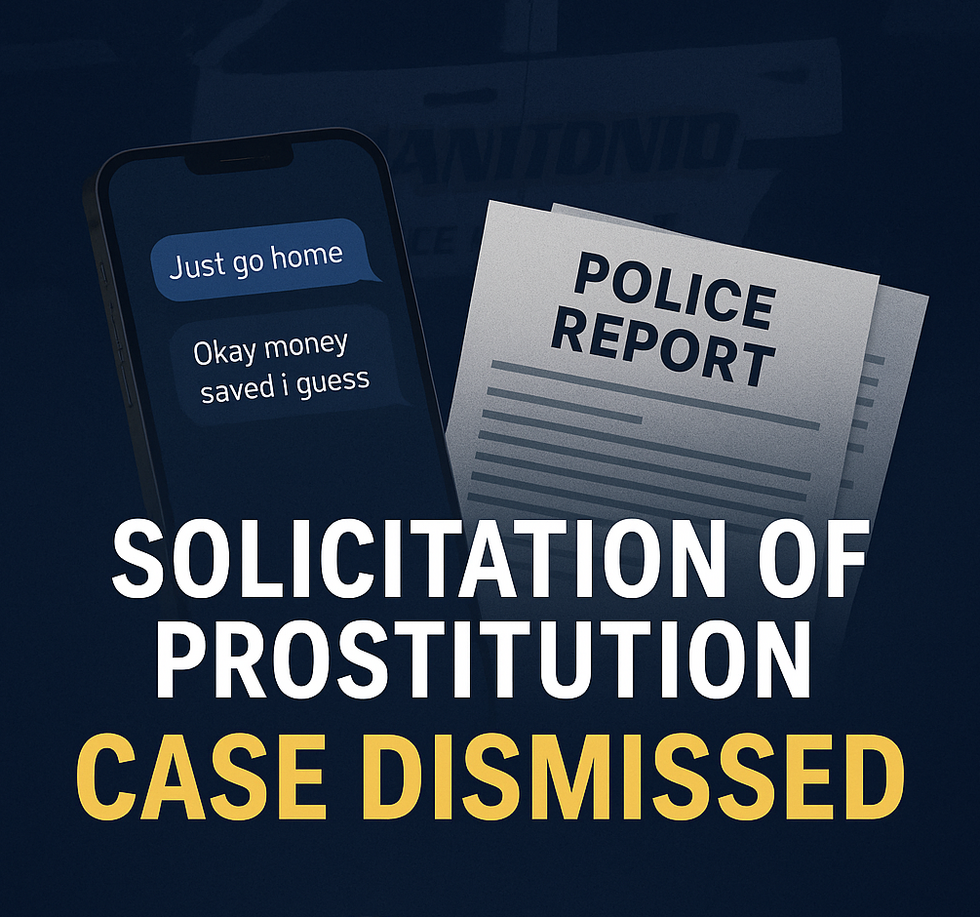
Texas Defenders recently secured a full dismissal for a client accused of Solicitation of Prostitution after being targeted in an SAPD/DPS sting operation. What initially appeared to be a straightforward undercover arrest quickly unraveled once we began dissecting the reports, digital evidence, and officer communications.
This case is a clear example of why early, aggressive defense work matters — and how a careful review of discovery can reveal major constitutional, procedural, and evidentiary problems that prosecutors often overlook.
Background: A Standard Sting Operation With Not-So-Standard Documentation
SAPD and DPS conducted an online solicitation operation in which undercover officers posed as escorts. After a brief text exchange, officers directed the client to a local hotel, where he was detained and charged.
But from the moment we opened the file, something was off. The narrative did not match the actual evidence, and the paperwork contained inconsistencies that raised serious questions about the accuracy and credibility of the State's case.
1. Material False Statements in the DPS Probable Cause Report
The DPS supplemental report contained multiple statements that were flatly contradicted by the text message thread:
-
Claim: The client requested the hotel location.
Truth: The undercover officer volunteered the location without being asked. -
Claim: The client requested the room number.
Truth: No such request appears anywhere in the messages. -
Claim: The undercover asked if the client was coming up, and he said yes.
Truth: These texts do not exist. The narrative was invented.
When a probable cause affidavit contains factual misrepresentations, the entire legitimacy of the arrest becomes questionable.
2. The Complaint Was Dated 10 Years Off
The formal charging instrument was dated March 21, 2013 — a decade before the alleged conduct.
While clerical errors happen, a ten-year mistake on a sworn complaint is no small detail. It underscored the sloppiness surrounding the case and weakened the reliability of the prosecution's paperwork.
3. The Report Misrepresented the Evidence About the Client's Phone
DPS stated that officers were unable to perform a “test text” because the client did not have his phone on him.
But body-camera footage showed officers recovering his phone at the scene and placing it in a labeled evidence bag.
Even more troubling:
The text message log contained a “Test JFO” message from a person not involved in the sting — further raising concerns about authentication, chain of custody, and the accuracy of DPS's statements.
4. The Recorded Calls Contradicted the Written Reports
DPS reported that the client asked for the hotel address during a recorded phone call.
He never did.
In every recording, officers — not the client — volunteered the address and hotel name. The report's version of events was simply not supported by the audio evidence.
5. Evidence of Entrapment: Repeated Officer Pressure to Induce Participation
The strongest defense issue stemmed from the conduct of the undercover female officer. Rather than allowing the conversation to develop naturally, she:
-
Called the client three separate times urging him to come to the hotel.
-
Continued calling even after he texted, “Okay money saved I guess,” signaling he was not planning to follow through.
-
Applied heavy pressure once he arrived, repeatedly telling him to come upstairs.
The law distinguishes between offering an opportunity to commit a crime and actively inducing someone who is reluctant.
Here, the conduct strongly suggested the latter.
6. “Any Agreement” Never Materialized
By the time the client texted “Okay money saved I guess,” the undercover officer had already told him:
“Just go home.”
This is not evidence of a completed agreement — it is evidence of the absence of one. The State's own evidence showed communication breaking down, not solidifying into an offense.
Defense Strategy: Expose the Inconsistencies and Build an Entrapment Theory
Our team compiled:
-
Contradictions between reports and actual messages
-
Errors in the complaint
-
Video and audio evidence disproving officer statements
-
Entrapment-supporting behavior in the repeated calls and pressure tactics
-
Weaknesses in text authentication and chain of custody
We presented a detailed analysis to the District Attorney's Office demonstrating not only that the case was flawed, but that prosecuting it risked constitutional and evidentiary problems.
Result: Full Dismissal After Completion of an Online Class
After reviewing the issues we identified, the DA's Office agreed the case could not withstand scrutiny. The client completed a short online human-trafficking education course as a condition of dismissal, and the State formally dropped the charge.
Why This Case Matters
Many sting-operation cases look strong on the surface. But as this dismissal proves, the details matter:
-
Reports can be inaccurate.
-
Evidence is sometimes misrepresented.
-
Officers may overstep.
-
A client's hesitation or withdrawal can be ignored in the narrative.
Texas Defenders approaches every case with the assumption that the discovery must be independently verified — never blindly accepted.
Practice area(s): Criminal Defense
Court: Bexar County Criminal District Court