
Assault Charge Dismissed After Texas Defenders Challenges Flock Camera Evidence and Mistaken Identification in Richardson, Texas
November 2026
Assault Charge Dismissed After Texas Defenders Challenges Flock Camera Evidence and Mistaken Identification in Richardson, Texas
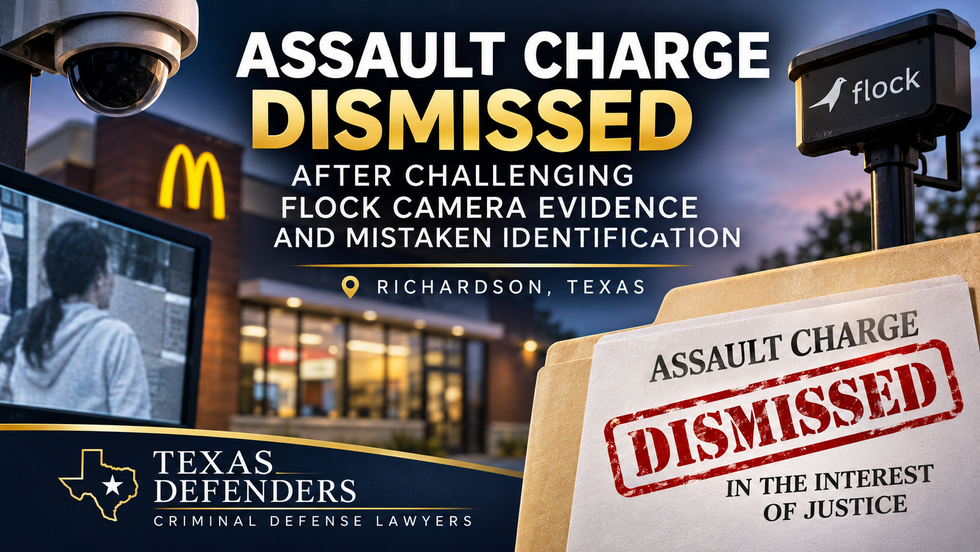
Case Result: DISMISSED — Interest of Justice
Charge: Assault Causing Bodily Injury — Class A Misdemeanor
Location: Richardson, Texas — Dallas County
Court: Dallas County Criminal Court No. 9
Case Number: M2545150
Date of Dismissal: November 3, 2026
Texas Defenders Secures Dismissal in Richardson Assault Case Involving Flock Cameras and Mistaken Identity
Texas Defenders successfully defended a client accused of assault causing bodily injury following an incident at a McDonald's restaurant in Richardson, Texas. After challenging the police department's identification of our client and raising serious questions about missing evidence from the Flock automated license plate recognition system, the Dallas County District Attorney's Office dismissed the criminal charge in the interest of justice.
The case demonstrates how an investigation can go wrong when law enforcement connects a vehicle to a person and then assumes that person committed a crime.
Our client maintained that she was not the individual depicted in the restaurant's surveillance video. Yet police identified her as the suspect after tracing a vehicle's license plate to her name and comparing her driver's license photograph to the surveillance footage.
The defense challenged that identification and investigated the evidence supporting it.
Ultimately, the prosecution dismissed the case.
How the Assault Allegation Began
On January 3, 2025, Richardson Police Department officers responded to a reported disturbance at a McDonald's restaurant located at 550 Centennial Boulevard in Richardson, Texas.
According to the police report, a customer became upset after being told that a freshly prepared pie would take approximately 12 minutes.
The customer reportedly exited a gold Toyota Avalon, entered the restaurant, and requested a refund. During the confrontation, the customer allegedly threw an ice cream cone that struck a restaurant manager in the face.
The manager reported experiencing pain, and officers documented a visible red mark.
The incident was captured on the restaurant's surveillance system.
The central question in the case was not simply whether an assault occurred.
The critical question was whether police had correctly identified the person responsible.
Our client disputed that she was the individual shown in the surveillance video.
How Richardson Police Used Flock Cameras to Identify Our Client
According to the offense report, an employee reportedly photographed the suspect's vehicle, including its license plate.
The investigating officer identified the vehicle as a gold Toyota Avalon bearing a Texas license plate.
The officer also reported checking the Flock automated license plate recognition system and observing the vehicle traveling southbound on Audelia Road shortly after the incident.
Flock cameras are automated license plate recognition cameras used by law enforcement agencies to record vehicle information, including license plates, vehicle descriptions, locations, and timestamps.
Police can use these systems to investigate crimes and identify vehicles that may have traveled through particular areas.
However, identifying a vehicle is not the same as identifying the person driving it.
After obtaining the vehicle's registration information, the Richardson officer connected the vehicle to our client.
The officer then obtained her driver's license photograph and compared it with the restaurant surveillance video.
Based on that comparison, the officer concluded that our client was the person who threw the ice cream cone.
A detective subsequently reviewed the surveillance footage and also reported that the suspect resembled our client.
Neither officer had personally witnessed the alleged assault.
The Problem: The Person in the Surveillance Video Was Not Our Client
Texas Defenders reviewed the identification evidence and challenged the conclusion that our client was the individual depicted in the restaurant's surveillance footage.
The defense maintained that the person shown in the video was visibly different from our client.
This raised a fundamental concern about the investigation.
Police had identified the registered owner of a vehicle and then used that person's driver's license photograph to identify the suspect.
But vehicle ownership alone does not establish who was driving a vehicle on a particular day.
It also does not establish who entered a restaurant or committed an alleged assault.
A vehicle may be driven by a family member, friend, or another person with access to it.
The prosecution still had to prove beyond a reasonable doubt that our client was the individual who committed the alleged offense.
The defense challenged the assumption that a vehicle-registration record and an officer's visual comparison were sufficient to reliably establish the suspect's identity.
Missing Flock Camera Evidence Raises Additional Questions
During its investigation, Texas Defenders sought the underlying Flock camera evidence that Richardson police reportedly used to identify the vehicle.
That evidence was important because it could potentially establish what the officer searched for, what images appeared, which license plate was captured, and whether other vehicles were identified.
However, Richardson Police Department advised the prosecution that the original Flock search was no longer available.
In an October 26, 2026, email, a Richardson police detective explained that patrol officers generally did not save those searches and that the system's records extended back only 60 days.
As a result, the original Flock search could not be produced for the defense to independently examine.
This created important unanswered questions:
-
Did the officer identify an exact license plate match?
-
What image did the Flock camera capture?
-
What search criteria were used?
-
Were other vehicles returned by the search?
-
Could the original results have supported a different conclusion?
Without the original records, the defense could not independently verify the Flock search described in the police report.
The absence of the records did not automatically establish police misconduct or a constitutional violation. Nevertheless, their unavailability was a significant issue in evaluating the identification evidence.
The Missing License Plate Photograph
The police report also claimed that a McDonald's employee had taken a photograph of the suspect's vehicle showing its license plate.
However, the defense was not provided a photograph establishing the license plate number.
This created a second evidentiary concern.
The officer's identification of the vehicle was reportedly supported by two sources: the employee's photograph and the Flock camera search.
Yet neither underlying item was available to the defense for independent examination.
The police report also disclosed a discrepancy in the digital evidence system. Certain citizen-submitted evidence had been associated with an incorrect police incident number.
Texas Defenders scrutinized these issues because the identification of the vehicle was an important link in the prosecution's case.
If the vehicle identification could not be independently verified, that raised additional questions about the chain of reasoning used to identify our client.
Challenging the Police Identification
Texas Defenders examined the circumstances surrounding the officer's identification, including his reliance on the vehicle registration and driver's license photograph.
The investigation raised concerns about confirmation bias.
Confirmation bias can occur when an investigator identifies a potential suspect and then interprets additional evidence in a manner that supports that initial conclusion.
In this case, the officer first identified our client through the vehicle-registration information.
He then compared her driver's license photograph to the surveillance footage and concluded she was the suspect.
The police reports did not document a formal photographic lineup in which the restaurant manager or another eyewitness independently identified our client.
Although Texas law does not require a photographic lineup in every investigation, properly conducted eyewitness identification procedures can provide important safeguards against mistaken identification.
Texas Code of Criminal Procedure Article 38.20 establishes requirements concerning law-enforcement policies for photographic and live lineup procedures.
The defense examined whether the officers' identification methods provided a reliable basis for connecting our client to the alleged offense.
Texas Defenders Prepares to Challenge the Identification in Court
As the prosecution continued, Texas Defenders developed legal challenges addressing the identification evidence.
The defense strategy included examining the grounds for a potential hearing under Franks v. Delaware, 438 U.S. 154 (1978), which permits challenges to material false statements or omissions in warrant affidavits under specific circumstances.
The defense also prepared to challenge the admissibility and reliability of identification testimony under the Texas Rules of Evidence.
Those issues included whether the officers had an adequate foundation for identifying our client from surveillance footage and whether testimony concerning the missing photographs and Flock records could be properly supported.
The defense further examined potential discovery issues under Article 39.14 of the Texas Code of Criminal Procedure.
These legal challenges were directed at a fundamental issue: whether the State could reliably establish that our client was the individual depicted in the surveillance video.
The defense was prepared to require the prosecution to prove that identification beyond a reasonable doubt.
Case Dismissed in the Interest of Justice
On November 3, 2026, the Dallas County District Attorney's Office dismissed the assault charge against our client in the interest of justice.
Our client avoided a criminal conviction on the Class A misdemeanor assault charge.
A Class A misdemeanor in Texas carries a potential punishment of up to one year in county jail and a fine of up to $4,000.
The dismissal ended the prosecution without requiring our client to plead guilty or proceed to trial.
Importantly, the dismissal was entered by the prosecution. It was not a judicial finding that Richardson police intentionally destroyed evidence, nor was it a court ruling suppressing the identification.
Nevertheless, the outcome was a significant victory for our client, who had maintained that she was not the person depicted in the surveillance footage.
Why This Case Matters for People Accused of Crimes Based on Flock Camera Evidence
Automated license plate recognition technology is increasingly used in criminal investigations throughout Texas.
Police departments may use Flock cameras to identify vehicles associated with reported crimes, locate vehicles, and develop investigative leads.
But these systems have limitations.
A license plate recognition camera generally identifies information associated with a vehicle—not the identity of the driver.
Even an accurate license plate match does not necessarily establish who was operating the vehicle or whether its registered owner committed a crime.
When police use vehicle-registration information to identify a criminal suspect, defense attorneys should carefully examine the additional evidence connecting that person to the alleged offense.
That examination may include the original camera images, search history, surveillance footage, eyewitness identification procedures, and other corroborating evidence.
This Richardson assault case illustrates why those distinctions matter.
A person should not be convicted of a crime simply because a vehicle associated with that person was connected to an investigation.
The State must prove the accused person's identity and every element of the charged offense beyond a reasonable doubt.
Can Flock Camera Evidence Be Challenged in a Texas Criminal Case?
Yes. Depending on the facts, a Texas criminal defense attorney may challenge evidence derived from automated license plate recognition systems.
Potential issues include the accuracy of the plate identification, the reliability of vehicle matching, whether the underlying records were preserved, and whether investigators correctly connected the vehicle to the accused person.
In some cases, constitutional challenges may also arise concerning how evidence was obtained or how a warrant was supported.
However, the mere use of a Flock camera does not automatically violate the Fourth Amendment, and missing Flock evidence does not automatically require dismissal.
Each case requires a careful examination of the actual evidence and the legal grounds for challenging it.
Arrested for Assault or Wrongfully Identified in Dallas County?
If you have been accused of assault, mistaken for someone else in surveillance footage, or charged after police identified a vehicle through a Flock camera, an experienced criminal defense attorney can examine the evidence supporting the accusation.
Texas Defenders represents clients facing criminal charges throughout Dallas County, including Richardson, Dallas, Garland, Mesquite, and surrounding communities.
Our criminal defense attorneys investigate the evidence, challenge unreliable identifications, and work to protect our clients' rights.
Texas Defenders — Criminal Defense Attorneys
3302 Swiss Circle
Dallas, Texas 75204
Call 214-306-9696 — Available 24/7
Case Result: Assault Causing Bodily Injury — DISMISSED IN THE INTEREST OF JUSTICE
Every criminal case is different. Past results do not guarantee a similar outcome in another case.
Practice area(s): Criminal Defense
Court: Dallas County Criminal Court